Rejecter,
I love your blog and spent most of this morning going through the archives. Your sense of humor had me literally, not figuratively, laughing out loud. (Invisible gorillas on a plane sent me on a laughing jag that had me crying.) After reading through several posts and responses and such, I'm struck by the following question:
Is it possible that New Yorkers are the wrong people to be deciding what America likes to read? Is it concievable that they are perhaps a bit to jaded/cynical/angry (you know, New Yorkerish) to make the necessary decisions regarding the value of literature?
I ask this as someone who understands that to live there and thrive you need an ego the size of John Edwards' mansion. Since I have a comparable ego and I'm sometimes reminded, usually by my wife, that I'm not as clever as I think I am, I feel fully qualified to ask this question and the response would fascinate me.
Hey, that's mean! Let me get out my stabbing knife. I'll cut you, man. I'll cut you.
But seriously, instead of quoting what I heard on the subway last week, let me actually answer your question. With a couple notations:
(1) Not all literary agents live and operate in New York. Many live in LA, and work mainly in film rights. Instead of being cynical and jaded I guess you can assume they are more phony and have better tans. Whatever you want to think. And there some legitimate agents who live in other states, because most of agency work is done over mail/fax/phone anyway, but these are usually people who know people in New York because they worked there at some point. It's a very "you have to know someone to get somewhere" industry (for those who work in it, not the writers), so being in New York is kinda crucial.
(2) Most literary agents were not born and raised in New York and do not, in fact, live there. They may have moved to New York in search of a career in publishing because it's rather necessary to do that, and once they made enough money, they bought a house in New Jersey and now they commute. For tax purposes, a lot of agencies and a couple publishing houses are based in places just outside of New York (like Bayonne or Lyndhurst), because taxes in New York State are really high.
(3) Not all New Yorkers are mean. That said, don't pick a fight with anyone on the 1 line between 96th Street and 137th. Seriously.
All joking and non-joking aside, if I wanted to be psychological about it, I would say that we seem jaded and cynical because the industry makes us that way. We happen to operate in an industry based on crushing people's hopes and dreams most of the time and then finding a few people who are actually great writers. We then champion those writers, and hopefully only half of them are crushed by some executive higher up on the line than we are. While not as bad as being that guy who stands outside the Spring store and hands out flyers all day to people who don't want his flyers, publishing is definitely a job that can get you down. Even when you find something great, odds are against it that it will succeed at all, much less to the extent that you want it to. It has to sell to a good company, get all the right attention, get good reviews, make a couple lists, and sell a lot of copies. Then, hopefully, the writer actually has enough talent for another book. (Some writers legitimately only have one book in them, especially if they're writing a memoir)
We operate this way because it's the only way to operate. I reject people because they're bad writers, or at the very least, are good writers with a bad book idea. But it's not quite the same as someone who works for Nabisco and is in charge of deciding which new chip line will make it out next quarter. No one is emotionally invested in those chips. Writers, on the other hand, have poured their hearts and souls into their work. It's their baby, and we're killing it.
Sometimes we get letters from homeless people who have returns as post office boxes. We get letters from dying people who just want their story told. We get letters from paraplegic veterans. We get letters about SIDS. And if the material is good, we accept, but it rarely is. Once I asked my first boss about a homeless person's sci-fi novel, which sounded really bad. I felt really bad about rejecting him. She only shrugged and said, "I give to charities for the homeless. If his book is bad, we can't sell it."
Harsh? Yes. Realistic? Yes. The way the world turns? Yes. I don't think they would do it any differently in another city, because accepting bad writing would be a bad economic decision and the agency would go under if we couldn't sell our clients' manuscripts.
As for whether the New York crowd is qualified to make decisions, well, it's not actually that hard to tell bad writing from good writing. We get our skills from experience and reading a lot. None of that has anything to do with where the office is located.
Sunday, March 18, 2007
Thursday, March 15, 2007
Form Letter Codes
Rejecter,
I recently recieved a form letter rejection from a fiction magazine. The editor had circled the stock phrases, "does not meet our current needs" and "please submit to us in the future." The editor also underlined the word "current." Does this represent a legitimate interest in my work on the part of the editor or should I just assume that a form letter of any kind is a flat out rejection?
Congratulations: You will never know the answer to this question. Assume it's a form letter.
I've been told there's actually a code to Fantasy & Science Fiction, the magazine that everyone submits to and no one gets accepted, but they get a really really fast reply (and by snail mail! So it took effort). There are different form letters they use, and the different ones indicate how far they got in your piece before they decided to reject it. I have a number of rejections from them, and they all have different wordings - "I didn't feel it was right for me" or "This doesn't meet our needs" and apparently there's a way to interpret these if you're a Fantasy & Science Fiction insider. If anyone wants to pitch in and tell us the code, I think everyone here would benefit. Everyone in science fiction submits a short story to F&SF. I've never met a single person who's read the magazine, but that's not the point here.
I recently recieved a form letter rejection from a fiction magazine. The editor had circled the stock phrases, "does not meet our current needs" and "please submit to us in the future." The editor also underlined the word "current." Does this represent a legitimate interest in my work on the part of the editor or should I just assume that a form letter of any kind is a flat out rejection?
Congratulations: You will never know the answer to this question. Assume it's a form letter.
I've been told there's actually a code to Fantasy & Science Fiction, the magazine that everyone submits to and no one gets accepted, but they get a really really fast reply (and by snail mail! So it took effort). There are different form letters they use, and the different ones indicate how far they got in your piece before they decided to reject it. I have a number of rejections from them, and they all have different wordings - "I didn't feel it was right for me" or "This doesn't meet our needs" and apparently there's a way to interpret these if you're a Fantasy & Science Fiction insider. If anyone wants to pitch in and tell us the code, I think everyone here would benefit. Everyone in science fiction submits a short story to F&SF. I've never met a single person who's read the magazine, but that's not the point here.
Wednesday, March 14, 2007
Adjectives and How I Hate Them
Dear Rejecter,
I'm wondering what genre to label my novel-mainstream/contemporary or the little checkbox on many agents' lists, "Offbeat/quirky." Now, I don't think "offbeat" is officially a genre, but if that's what my novel best fits into, should I call it that anyway? When the agent's reader encounters the surreal elements of my novel a mainstream/contemporary" tag is going to seem clueless, I fear. I am also trying, in my desperation, to avoid comparing my work to great works, because I know how often agents roll their eyes at every writer who thinks they're "the next great X." However, if I use a sparing simile here and there- I'm thinking of comparing the surreal effects as comparable to David Lynch, but with the black humor of Dr. Strangelove- might my query not get tossed? My friends tell me it's a strong novel, it's just very surreal. Is there any way to sell that today? What do you recommend for writers that have an odd but strong novel? How does one sell strange?
Must resist urge to say something mean.
Must resist urge to say something mean.
Deep breath....
...If you novel has strange things happen in it, that should be obvious from the summary in the first part of the query. We don't like people using adjectives to describe their novel - we like people who describe their novel and then happen to mention its genre, and "quirky" is not a genre. What's your novel about? Insane commanders ordering their men to drop nuclear weapons on an unsuspecting populace? A backwards-talking dwarf? If you mention that yeah, there is a backwards-talking dwarf in your story (and he's the killer! haha!), we will be able to figure out "Hey, this is pretty strange" and then decide if it meets our tastes based on that and a host of other reasons, like the quality of your writing in the query letter and/or the partial.
Do not use words to describe your novel - and this goes for everyone - that are not words used by bookstores to define genre so that they can put it on the correct shelf. If you don't know and the genre isn't obvious, that means it's probably just fiction and would go in that "fiction and literature" section. We can tell from the summary. Don't label it as "great" or "funny" or "strange" or "the next bestseller." And I don't know why everyone's memoirs about how they were brutally raped by their fathers involves "a touch of humor" and I refuse to believe it until I see it, and I usually don't want to see it. Everyone, stop saying your novel is humorous if it so obviously isn't because you just said it was about how your wife died of cancer. That's not funny. You have to be a pretty brilliant humorist to make that funny.
Sorry, poster - that last bit didn't involve you so much, but we're seeing a lot of those these days. Everybody's writing dark comedy, but every "dark comedy" manuscript I've seen isn't very funny.
I'm wondering what genre to label my novel-mainstream/contemporary or the little checkbox on many agents' lists, "Offbeat/quirky." Now, I don't think "offbeat" is officially a genre, but if that's what my novel best fits into, should I call it that anyway? When the agent's reader encounters the surreal elements of my novel a mainstream/contemporary" tag is going to seem clueless, I fear. I am also trying, in my desperation, to avoid comparing my work to great works, because I know how often agents roll their eyes at every writer who thinks they're "the next great X." However, if I use a sparing simile here and there- I'm thinking of comparing the surreal effects as comparable to David Lynch, but with the black humor of Dr. Strangelove- might my query not get tossed? My friends tell me it's a strong novel, it's just very surreal. Is there any way to sell that today? What do you recommend for writers that have an odd but strong novel? How does one sell strange?
Must resist urge to say something mean.
Must resist urge to say something mean.
Deep breath....
...If you novel has strange things happen in it, that should be obvious from the summary in the first part of the query. We don't like people using adjectives to describe their novel - we like people who describe their novel and then happen to mention its genre, and "quirky" is not a genre. What's your novel about? Insane commanders ordering their men to drop nuclear weapons on an unsuspecting populace? A backwards-talking dwarf? If you mention that yeah, there is a backwards-talking dwarf in your story (and he's the killer! haha!), we will be able to figure out "Hey, this is pretty strange" and then decide if it meets our tastes based on that and a host of other reasons, like the quality of your writing in the query letter and/or the partial.
Do not use words to describe your novel - and this goes for everyone - that are not words used by bookstores to define genre so that they can put it on the correct shelf. If you don't know and the genre isn't obvious, that means it's probably just fiction and would go in that "fiction and literature" section. We can tell from the summary. Don't label it as "great" or "funny" or "strange" or "the next bestseller." And I don't know why everyone's memoirs about how they were brutally raped by their fathers involves "a touch of humor" and I refuse to believe it until I see it, and I usually don't want to see it. Everyone, stop saying your novel is humorous if it so obviously isn't because you just said it was about how your wife died of cancer. That's not funny. You have to be a pretty brilliant humorist to make that funny.
Sorry, poster - that last bit didn't involve you so much, but we're seeing a lot of those these days. Everybody's writing dark comedy, but every "dark comedy" manuscript I've seen isn't very funny.
Monday, March 12, 2007
Oooo! Mysterious Disk!
One of the newer trends has been for people to supple CDs with their query letters, or in the most extreme cases, just the CD. Let me explain to you how bad an idea this is: This is a really bad idea. Not only do we need like to have to do extra work, there is nothing I, as a person, like doing more than putting a mysterious disk I got in the mail from a total stranger into my beloved laptop.
Now I've heard sarcasm is hard to detect on the internet, so let me be clear: That last line was sarcastic. It's like attachments, which any agent website will tell you not to send, but so much worse. At least with attachments we can scan them for viruses.
And while we're on the subject: If you send an SASE for the return of your CD, make sure your CD fits in the envelope.
Now I've heard sarcasm is hard to detect on the internet, so let me be clear: That last line was sarcastic. It's like attachments, which any agent website will tell you not to send, but so much worse. At least with attachments we can scan them for viruses.
And while we're on the subject: If you send an SASE for the return of your CD, make sure your CD fits in the envelope.
Friday, March 09, 2007
The Secret: Magic is real! Santa Claus exists!
A previous poster asked about The Secret, and if it inspired the current inspirational book phase. I can say that no, it did not. It's just the latest, most awful movie/book in a long succession of awful books that make us hate people's query letters because they think they can write them because honestly, they look pretty easy to write. Well, they're not, so stop it.
As to why The Secret is such a success, the short answer is of course that people are stupid. That's all I was going to write, but then I realized that blogs are meant for long, rambling monologues where the poster insults the readers' political/spiritual/moral beliefs, and that writing about something other than my mystery virus would distract me from the headache that is caused by my mystery virus. Don't start a publishing company.
Self-help and inspirational books have existed since the beginning of contemporary publishing, whenever that was (sometime this century). It exists as a genre because there's a great demand for it, for the most part by bored people who want to improve themselves or their lives, and I support the idea of buying a book about carpentry and building a birdhouse. Sure it'll fall apart next week, but you'll feel better about the crappy Dilbert job you have and feel like you accomplished something, even if the thing was just glued together and your area doesn't have many birds.
Then there's "inspirational" books, a term I take to mean, "at least vaguely-Christian watered-down spirituality, sometimes in the form of old man wisdom." On a certain level I admire a person who can find total happiness in life with a $7.95 paperback on the bargain rack at CVS. It's a lot cheaper than my synagogue membership and this person probably has way more free time than I do. I'm busy trying to figure out if I can put the chili on the hot plate on Saturday morning because the chili is so watery that it might cook the water, which is a violation of one of the 39 labors forbidden by G-d to perform on the Sabbath (as opposed to solid food, which cannot be re-cooked), and this person is at the movies or the theater or riding a bike. Who knows.
On the other hand, most people who turn to the bargain rack at CVS for meaning in their lives are probably in pretty dire straits in terms of finding that meaning. Allow me to sum them all up in one sentence:
If you have a more positive attitude, your crappy life will not seem so crappy, because you have a positive attitude about it.
This does not, however, actually change the quality of your life, as these books lead you to believe. It may, but it depends what you're up against. Cancer, not so much. These sorts of books have a double-edged sword that can cut you, to take the metaphor way too far. If you believe that you will recover from an illness by positive thinking and then you don't, you might come to the very logical conclusion that it's your fault that you're ill because you didn't think hard enough about how much better you were going to get.
You may have guessed at this point that I'm speaking from experience. When I was newly diagnosed with Crohn's Disease a lot of this mind-body shit was shoved down my throat to the point where I actually believed it, and when my surgical procedure did arguably more harm than good and the complication nearly killed me, I thought it was my fault. It wasn't a hyperactive N-protein in my immune system causing inflammation to my lower intestines that was the problem. It was my bad attitude.
When I realized that was complete bullshit, I felt much better - about my life, at least. I didn't actually feel better health-wise, further proving my point.
The problem with The Secret and the reason that it's caused so much controversy is that it takes this basic concept to the extreme of wish fulfillment. There's apparently a segment in the original video on which the book was based in which a woman wishes for a gold necklace around her next, and because she wishes hard enough, the necklace appears. At this point I can't help but think of Patrick Swayze's slimy motivational speaker in Donnie Darko, who turns out to be a kiddie porn addict. At one point in the movie, the gym teacher (who is a devotee) makes the class watch one of the videos and says that all of human experience can be put into the categories of either fear or love, to which Donnie angrily replies:
Donnie Darko: "I just don't get this. You can't just lump things into two categories. Things aren't that simple."
Gym Teacher: "The lifeline is divided that way."
Donnie Darko: "Well, life isn't that simple. Who cares of Ling Ling returns the wallet and keeps the money? It has nothing to do with either fear or love."
Gym Teacher: "Fear and love are the deepest of human emotions."
Donnie Darko: "...Okay. But you're not listening to me. There are other things that have to be taken into account here - like, the whole spectrum of human emotions! You can't just lump everything into these two categories and just deny everything else!"
Needless to say, when the gym teacher threatens him with a failing grade, he replies with something that involves shoving a card up where the sun doesn't shine and earns himself a visit to the principal's office.
The Secret isn't just stupid; it's dangerous. Telling people that they will just get things by wishing for them is only moral if you happen to inhabit a Disney movie, and not one of those ones where the parent of the protagonist dies. The idea does work in some circumstances; if you happen to be standing in the middle of the road on a misty day and wish to be hit by a car, you might get your wish, and then Rod Sterling might step out of the bushes and talk to the camera about how stupid you were.
One of the many professors and doctors trotted out on the video was recently interviewed about the infamous "necklace scene" - to which he replied that it wasn't meant to be "taken so literally" and had clearly no idea the lengths to which Rhonda Byrne was willing to take things to sell more copies of her video. She even wound up on Oprah with her new book. Oprah's a fairly intelligent woman (she's very good at making people feel better about themselves, which is a talent), but she has a tendency to fall for literary shysters.
It's one thing to be a semi-talented writer and speaker who knows how to lump extremely conventional wisdom together into a book and have it be a bestseller. It's another thing to tell people that wishes come true.
For everyone's information, we get submissions like The Secret all the time from people who think they have figured out the secrets of the universe or how to do real magic or the date that Christ is coming back and the exact set of things we have to do to bring him along. We call these people "crazy" and trash their query letters. Sure, a couple of them might be written well enough to sell a bajillion copies to, but we like to sleep at night.
As to why The Secret is such a success, the short answer is of course that people are stupid. That's all I was going to write, but then I realized that blogs are meant for long, rambling monologues where the poster insults the readers' political/spiritual/moral beliefs, and that writing about something other than my mystery virus would distract me from the headache that is caused by my mystery virus. Don't start a publishing company.
Self-help and inspirational books have existed since the beginning of contemporary publishing, whenever that was (sometime this century). It exists as a genre because there's a great demand for it, for the most part by bored people who want to improve themselves or their lives, and I support the idea of buying a book about carpentry and building a birdhouse. Sure it'll fall apart next week, but you'll feel better about the crappy Dilbert job you have and feel like you accomplished something, even if the thing was just glued together and your area doesn't have many birds.
Then there's "inspirational" books, a term I take to mean, "at least vaguely-Christian watered-down spirituality, sometimes in the form of old man wisdom." On a certain level I admire a person who can find total happiness in life with a $7.95 paperback on the bargain rack at CVS. It's a lot cheaper than my synagogue membership and this person probably has way more free time than I do. I'm busy trying to figure out if I can put the chili on the hot plate on Saturday morning because the chili is so watery that it might cook the water, which is a violation of one of the 39 labors forbidden by G-d to perform on the Sabbath (as opposed to solid food, which cannot be re-cooked), and this person is at the movies or the theater or riding a bike. Who knows.
On the other hand, most people who turn to the bargain rack at CVS for meaning in their lives are probably in pretty dire straits in terms of finding that meaning. Allow me to sum them all up in one sentence:
If you have a more positive attitude, your crappy life will not seem so crappy, because you have a positive attitude about it.
This does not, however, actually change the quality of your life, as these books lead you to believe. It may, but it depends what you're up against. Cancer, not so much. These sorts of books have a double-edged sword that can cut you, to take the metaphor way too far. If you believe that you will recover from an illness by positive thinking and then you don't, you might come to the very logical conclusion that it's your fault that you're ill because you didn't think hard enough about how much better you were going to get.
You may have guessed at this point that I'm speaking from experience. When I was newly diagnosed with Crohn's Disease a lot of this mind-body shit was shoved down my throat to the point where I actually believed it, and when my surgical procedure did arguably more harm than good and the complication nearly killed me, I thought it was my fault. It wasn't a hyperactive N-protein in my immune system causing inflammation to my lower intestines that was the problem. It was my bad attitude.
When I realized that was complete bullshit, I felt much better - about my life, at least. I didn't actually feel better health-wise, further proving my point.
The problem with The Secret and the reason that it's caused so much controversy is that it takes this basic concept to the extreme of wish fulfillment. There's apparently a segment in the original video on which the book was based in which a woman wishes for a gold necklace around her next, and because she wishes hard enough, the necklace appears. At this point I can't help but think of Patrick Swayze's slimy motivational speaker in Donnie Darko, who turns out to be a kiddie porn addict. At one point in the movie, the gym teacher (who is a devotee) makes the class watch one of the videos and says that all of human experience can be put into the categories of either fear or love, to which Donnie angrily replies:
Donnie Darko: "I just don't get this. You can't just lump things into two categories. Things aren't that simple."
Gym Teacher: "The lifeline is divided that way."
Donnie Darko: "Well, life isn't that simple. Who cares of Ling Ling returns the wallet and keeps the money? It has nothing to do with either fear or love."
Gym Teacher: "Fear and love are the deepest of human emotions."
Donnie Darko: "...Okay. But you're not listening to me. There are other things that have to be taken into account here - like, the whole spectrum of human emotions! You can't just lump everything into these two categories and just deny everything else!"
Needless to say, when the gym teacher threatens him with a failing grade, he replies with something that involves shoving a card up where the sun doesn't shine and earns himself a visit to the principal's office.
The Secret isn't just stupid; it's dangerous. Telling people that they will just get things by wishing for them is only moral if you happen to inhabit a Disney movie, and not one of those ones where the parent of the protagonist dies. The idea does work in some circumstances; if you happen to be standing in the middle of the road on a misty day and wish to be hit by a car, you might get your wish, and then Rod Sterling might step out of the bushes and talk to the camera about how stupid you were.
One of the many professors and doctors trotted out on the video was recently interviewed about the infamous "necklace scene" - to which he replied that it wasn't meant to be "taken so literally" and had clearly no idea the lengths to which Rhonda Byrne was willing to take things to sell more copies of her video. She even wound up on Oprah with her new book. Oprah's a fairly intelligent woman (she's very good at making people feel better about themselves, which is a talent), but she has a tendency to fall for literary shysters.
It's one thing to be a semi-talented writer and speaker who knows how to lump extremely conventional wisdom together into a book and have it be a bestseller. It's another thing to tell people that wishes come true.
For everyone's information, we get submissions like The Secret all the time from people who think they have figured out the secrets of the universe or how to do real magic or the date that Christ is coming back and the exact set of things we have to do to bring him along. We call these people "crazy" and trash their query letters. Sure, a couple of them might be written well enough to sell a bajillion copies to, but we like to sleep at night.
Tuesday, March 06, 2007
Indepedent Publishing
The answer to where I've been is: in bed. Apparently starting your own publishing company while being a full time student and having two other jobs can cause your body to like, collapse for a week. Or two.
Which brings us to our topic, which is self-publishing. Yes, the much-maligned business of publishing your own books using either a digital printer or a POD service. There are three reasons to self-publish:
(1) You have written a body of work intended for a small audience (under 100 people) and just want it bound so that it's easier to read and this audience is willing to spend a lot of money to get it.
(2) You want to reprint a public domain book that has not been printed in a very long time and is very hard to get for a niche audience that you know will buy it like mad, but generally have no plans for mass market.
(3) You are an idiot or a terrible writer with lots of money to blow.
I fell into category number two. I discovered that this book that a group of people (a few hundred) wanted had gone horribly out of print to the point that the New York Public Library only had one copy in the reading room and they wouldn't let me take it out. After some investigation I also discovered that the book had fallen into public domain in the 70's with a lot of other books published between 1932 and 1950 because the original publishers had never renewed the copyright. I decided to reprint it by scanning it in to my computer after photocopying it at the reading room, writing an introduction, and start collecting quotes from digital printers. I would (or will) probably make back the money I invested in the project (roughly $500) and then maybe a few thousand on top of that, much of which would go to charity. The real intent was to get the book back in print. As someone who loves books and collects them, I feel it's sort of a public responsibility to make sure literature doesn't disappear because of circumstance and time.
I decided not to go with a POD press, which would have been really easy in that they would have done stuff like layout and promotion and generally managing the project. They also would have taken most of the profits, and I decided I didn't want that,. Since I work in publishing, I should probably have some idea how to do layout myself anyway, so instead I looked into digital printers, who are willing to do print runs in the 100-300 range for about $5 a book. I charge for shipping and handling, and the everything in between on the cover price (in the $15 range) is profit.
Other than causing a physical collapse from exhaustion, this little (and still ongoing) exercise taught me a thing or two about how much it takes to actually create a book. It's true that the amount an author makes on a book is low. Most of it goes to the publishing company, because no matter how altruistic they are, they still have to pay their employees and they still have to make a profit. And boy, are there a lot of little jobs to pay people for. There's layout, copy-editing, proof reading, buying the ISBN, cover art, deciding on various types of binding, and last but not least, making sure the book does not look like crap or fall apart in anybody's hands. Companies have choices beyond hardcover and softcover. There's paper weight, thickness, and quality. There's the size of the book, which lowers page count but increases the price of binding. There's things like what font to use and how much of the page to leave blank (more white space makes the book look more professional, but raises page count). And then, at the very end, there's me, trying to make sense of all of the options the digital printer's website is giving me. (matte instead of gloss costs more but looks better. How much more? Can I get a new quote for 300 versus 200 copies?)
Oh, and publicity. The biggest job and the one I'm totally unequipped to do, being one person. Thank G-d I'm only doing this for a niche market that I already am in contact with. There's more to it than posting your book on Amazon. In fact, you don't really want to post your book on Amazon. Amazon takes a high commission - higher than bookstores, in fact, which is how it can afford to offer you, the buyer, all of those discounts. Bookstores generally take 50% off the cover price for themselves, while Amazon.com and other websites will take 55%, a very significant difference. It's quite brilliant, actually. They offer discounts and then offer super shipper savings so that you'll buy more books than you originally planned to do, knowing that they'll make it up in bulk shipping as opposed to individual purchases. Also, they take most of the money from the used market. There's a flat rate of $3.49 for shipping on a used book sold through Amazon - Amazon will take half of that, and then a percentage from the price the book is actually being sold for, to the point where the sellers might actually be losing money if the book is very heavy and media mail goes over $2.00.
So, it has all been kind of insane, and will continue to be until I get over the initial hump of selling off my first run (if there even is a second run; I could care less), but now at least I'm back on my feet. Today was a much easier day for me in terms of working at the office because I felt better. It didn't result in more maybes - lots of auto-rejects instead. We're in the middle of an inspirational self-help craze the way we were in a Da Vinci Code-type thriller phase about a year ago, and it's just as annoying, but in a different way.
Which brings us to our topic, which is self-publishing. Yes, the much-maligned business of publishing your own books using either a digital printer or a POD service. There are three reasons to self-publish:
(1) You have written a body of work intended for a small audience (under 100 people) and just want it bound so that it's easier to read and this audience is willing to spend a lot of money to get it.
(2) You want to reprint a public domain book that has not been printed in a very long time and is very hard to get for a niche audience that you know will buy it like mad, but generally have no plans for mass market.
(3) You are an idiot or a terrible writer with lots of money to blow.
I fell into category number two. I discovered that this book that a group of people (a few hundred) wanted had gone horribly out of print to the point that the New York Public Library only had one copy in the reading room and they wouldn't let me take it out. After some investigation I also discovered that the book had fallen into public domain in the 70's with a lot of other books published between 1932 and 1950 because the original publishers had never renewed the copyright. I decided to reprint it by scanning it in to my computer after photocopying it at the reading room, writing an introduction, and start collecting quotes from digital printers. I would (or will) probably make back the money I invested in the project (roughly $500) and then maybe a few thousand on top of that, much of which would go to charity. The real intent was to get the book back in print. As someone who loves books and collects them, I feel it's sort of a public responsibility to make sure literature doesn't disappear because of circumstance and time.
I decided not to go with a POD press, which would have been really easy in that they would have done stuff like layout and promotion and generally managing the project. They also would have taken most of the profits, and I decided I didn't want that,. Since I work in publishing, I should probably have some idea how to do layout myself anyway, so instead I looked into digital printers, who are willing to do print runs in the 100-300 range for about $5 a book. I charge for shipping and handling, and the everything in between on the cover price (in the $15 range) is profit.
Other than causing a physical collapse from exhaustion, this little (and still ongoing) exercise taught me a thing or two about how much it takes to actually create a book. It's true that the amount an author makes on a book is low. Most of it goes to the publishing company, because no matter how altruistic they are, they still have to pay their employees and they still have to make a profit. And boy, are there a lot of little jobs to pay people for. There's layout, copy-editing, proof reading, buying the ISBN, cover art, deciding on various types of binding, and last but not least, making sure the book does not look like crap or fall apart in anybody's hands. Companies have choices beyond hardcover and softcover. There's paper weight, thickness, and quality. There's the size of the book, which lowers page count but increases the price of binding. There's things like what font to use and how much of the page to leave blank (more white space makes the book look more professional, but raises page count). And then, at the very end, there's me, trying to make sense of all of the options the digital printer's website is giving me. (matte instead of gloss costs more but looks better. How much more? Can I get a new quote for 300 versus 200 copies?)
Oh, and publicity. The biggest job and the one I'm totally unequipped to do, being one person. Thank G-d I'm only doing this for a niche market that I already am in contact with. There's more to it than posting your book on Amazon. In fact, you don't really want to post your book on Amazon. Amazon takes a high commission - higher than bookstores, in fact, which is how it can afford to offer you, the buyer, all of those discounts. Bookstores generally take 50% off the cover price for themselves, while Amazon.com and other websites will take 55%, a very significant difference. It's quite brilliant, actually. They offer discounts and then offer super shipper savings so that you'll buy more books than you originally planned to do, knowing that they'll make it up in bulk shipping as opposed to individual purchases. Also, they take most of the money from the used market. There's a flat rate of $3.49 for shipping on a used book sold through Amazon - Amazon will take half of that, and then a percentage from the price the book is actually being sold for, to the point where the sellers might actually be losing money if the book is very heavy and media mail goes over $2.00.
So, it has all been kind of insane, and will continue to be until I get over the initial hump of selling off my first run (if there even is a second run; I could care less), but now at least I'm back on my feet. Today was a much easier day for me in terms of working at the office because I felt better. It didn't result in more maybes - lots of auto-rejects instead. We're in the middle of an inspirational self-help craze the way we were in a Da Vinci Code-type thriller phase about a year ago, and it's just as annoying, but in a different way.
Tuesday, February 27, 2007
Professionalism
Maybe it's some self-conceived notion of professionalism mixed with a genuine sympathy for the first-novel potential author (being one myself), but I like to think that I'm never "in the mood to reject." Today I so barely walked the line on that, thankful that almost everything coming through was an auto-reject (too long, author doesn't know grammar, wrong genre for agent). I was wondering why that was until I went home and discovered I had a 100 degree fever. Mystery solved. I'm only up now because I'm between does of Tylenol.
In lieu of answering questions, which will have to wait, I will say that one of the most confounding things to happen to me at work is to read a partial from a high school English teacher who doesn't know proper grammar. I'm not talking about where commas go - those rules are actually fairly complicated. I'm talking about knowing to start each new speaker's dialogue with a new paragraph, and then using an indent to do so.
I was once in a fiction workshop with a woman who was and had been an English teacher for 20 years. Her story consisted of several long paragraphs in which many different speakers did many different incoherent things. Briefly I wondered if I should bother correcting her, as there was no way she couldn't actually not know the rules herself. I know English teachers. One of my roommates is an English teacher. Instead I politely inquired as to why she had decided to write her story that way, to which she replied something along the lines of, "Well, I really feel that it makes the piece work."
I hate this person. And that's not the fever speaking.
In lieu of answering questions, which will have to wait, I will say that one of the most confounding things to happen to me at work is to read a partial from a high school English teacher who doesn't know proper grammar. I'm not talking about where commas go - those rules are actually fairly complicated. I'm talking about knowing to start each new speaker's dialogue with a new paragraph, and then using an indent to do so.
I was once in a fiction workshop with a woman who was and had been an English teacher for 20 years. Her story consisted of several long paragraphs in which many different speakers did many different incoherent things. Briefly I wondered if I should bother correcting her, as there was no way she couldn't actually not know the rules herself. I know English teachers. One of my roommates is an English teacher. Instead I politely inquired as to why she had decided to write her story that way, to which she replied something along the lines of, "Well, I really feel that it makes the piece work."
I hate this person. And that's not the fever speaking.
Tuesday, February 20, 2007
I Feel Your Pain, Man
Miss Rejector,
What is the time frame for an agent to give a yay or nay for a ms they requested?
I met with an agent at a conference. She requested my full manuscript to be emailed to her, which I did. That was 6 weeks ago. I’m worried that the internet ate my email and she never got it. I don’t want to be an ass about it; I’m grateful she even wanted to see it. But should I contact her? Maybe send a note asking if she got it? Is 6 weeks too short a time?
You can contact her to see if she got it, but she probably has and probably hasn't read it. (Still, it's best to be on the safe side with email submissions) Six weeks, sadly, is not a long enough time for most agents to look at a full. Not that it takes them six weeks to read a novel, but they're not only reading the novel but actually considering taking this person on as a client, which is a major financial endeavor for them. They have to feel sure about it. That takes time.
Or at least, that's what I tell myself as I wait for a response from an agent on my full. I gave my mind four weeks to not get anxious, but man, this is getting brutal now that I'm into the second month.
What is the time frame for an agent to give a yay or nay for a ms they requested?
I met with an agent at a conference. She requested my full manuscript to be emailed to her, which I did. That was 6 weeks ago. I’m worried that the internet ate my email and she never got it. I don’t want to be an ass about it; I’m grateful she even wanted to see it. But should I contact her? Maybe send a note asking if she got it? Is 6 weeks too short a time?
You can contact her to see if she got it, but she probably has and probably hasn't read it. (Still, it's best to be on the safe side with email submissions) Six weeks, sadly, is not a long enough time for most agents to look at a full. Not that it takes them six weeks to read a novel, but they're not only reading the novel but actually considering taking this person on as a client, which is a major financial endeavor for them. They have to feel sure about it. That takes time.
Or at least, that's what I tell myself as I wait for a response from an agent on my full. I gave my mind four weeks to not get anxious, but man, this is getting brutal now that I'm into the second month.
Monday, February 19, 2007
In Which I Misemploy Fishing Analogies
I just stumbled across your blog and slunk through your latest posts and comments and I like what you said about what takes priority in a query letter: your story idea.
It seems like a lot of writers fuss about getting that query letter perfect (credits, how they found the agent, etc. all in the perfect place), when it seems to me that if you get the hook right, then you're going to get a call. You still shoot for perfection on your query letter, but 90% of your time should be in getting that hook dead on.
What do you think?
So it seems we're getting to the point in the blog where I'm getting repeat questions, at least partially. As to why you should try to get everything right in the query - spell the agent's name correctly, don't mention you're a first-time author with five previous rejected novels, don't try to be cute, don't hand-write it over five pages - that's just basic common sense. It's a job interview. Authors like to emphasize that the agents work for them, which is true, but the agent still gets to pick whom they work for, so it is in that sense like a job interview, with some of the elements reversed. And like a job interview, you want to look your best.
That said, it is all about the hook. This isn't entirely true - some credentials will float you into the maybe pile with only the barest summary of your new work - but it's not so much about having a great hook as having a bad one. A bad hook will sink you. Yes, I know hooks don't sink unless someone bites; it's a bad analogy, but my point stands: If your idea sucks, you will get nowhere, and all the fine-tuning in the world won't help that.
It seems like a lot of writers fuss about getting that query letter perfect (credits, how they found the agent, etc. all in the perfect place), when it seems to me that if you get the hook right, then you're going to get a call. You still shoot for perfection on your query letter, but 90% of your time should be in getting that hook dead on.
What do you think?
So it seems we're getting to the point in the blog where I'm getting repeat questions, at least partially. As to why you should try to get everything right in the query - spell the agent's name correctly, don't mention you're a first-time author with five previous rejected novels, don't try to be cute, don't hand-write it over five pages - that's just basic common sense. It's a job interview. Authors like to emphasize that the agents work for them, which is true, but the agent still gets to pick whom they work for, so it is in that sense like a job interview, with some of the elements reversed. And like a job interview, you want to look your best.
That said, it is all about the hook. This isn't entirely true - some credentials will float you into the maybe pile with only the barest summary of your new work - but it's not so much about having a great hook as having a bad one. A bad hook will sink you. Yes, I know hooks don't sink unless someone bites; it's a bad analogy, but my point stands: If your idea sucks, you will get nowhere, and all the fine-tuning in the world won't help that.
Thursday, February 15, 2007
Special Cases of Address
Dear Rejecter,
Another question. In the submission guidelines for a few of the agencies I want to query, their website says, write to the "Submissions Department", instead of any particular agent. In such cases, is it ok to write "Dear Agent" in the query letter, because I don't know which agent to address? Or, if I do get to know the name of a specific agent, is it advisable to write to her (and thus ignoring the submission guidelines)?
In this particular case, it is okay to write "Submissions Department" and not "Dear Agent." In most cases, however, the submissions department is usually defined as the corner of the agent's desk where the pile of mail was dropped in a rush to get to the phone.
Another question. In the submission guidelines for a few of the agencies I want to query, their website says, write to the "Submissions Department", instead of any particular agent. In such cases, is it ok to write "Dear Agent" in the query letter, because I don't know which agent to address? Or, if I do get to know the name of a specific agent, is it advisable to write to her (and thus ignoring the submission guidelines)?
In this particular case, it is okay to write "Submissions Department" and not "Dear Agent." In most cases, however, the submissions department is usually defined as the corner of the agent's desk where the pile of mail was dropped in a rush to get to the phone.
Monday, February 12, 2007
Degrees Needed For Publishing
Hello Miss Rejecter;
I've been checking out your blog ocasionally for a while and lately you've mentioned your studies. I was wondering how important the level of studies and the grades received are in order to become an assistant to a lit. agent. I'm on my last year of a B.A. in English and debating whether to go for honors or not. I'm not very interested in the work they ask for honors but I'll do it if it will make any difference in my chance of getting hired as soon after my graduation as possible. I suppose that since you are working in the industry you must know some people in it, what do you think? Do people with normal/non-outstanding degrees have a chance? Is it harder or easier?
In terms of writing (for future novelists out there) degrees do not matter at all. You don't even have to have gone to college to write a great book. In your case, it's nice to have a degree in English, but don't stress yourself over honors. It's not going to make a difference. When I applied to my first job in publishing all I had was a BA in history. Now I'm going for a useless MFA in fiction mainly because it gives me authorization to teach, should I ever burn out in the publishing world. It will not make any difference, so don't stress yourself.
I've been checking out your blog ocasionally for a while and lately you've mentioned your studies. I was wondering how important the level of studies and the grades received are in order to become an assistant to a lit. agent. I'm on my last year of a B.A. in English and debating whether to go for honors or not. I'm not very interested in the work they ask for honors but I'll do it if it will make any difference in my chance of getting hired as soon after my graduation as possible. I suppose that since you are working in the industry you must know some people in it, what do you think? Do people with normal/non-outstanding degrees have a chance? Is it harder or easier?
In terms of writing (for future novelists out there) degrees do not matter at all. You don't even have to have gone to college to write a great book. In your case, it's nice to have a degree in English, but don't stress yourself over honors. It's not going to make a difference. When I applied to my first job in publishing all I had was a BA in history. Now I'm going for a useless MFA in fiction mainly because it gives me authorization to teach, should I ever burn out in the publishing world. It will not make any difference, so don't stress yourself.


Saturday, February 10, 2007
The Book "Blind Submission"
All of my life, people have constantly been recommending books to me. I don't if there's something in my genetic code that sets off a pheromone that causes people to instantly think of a book I must read or what, but let me tell you that it is extremely annoying. I read books for fun, for school, for research, and for a living. One can safely assume that I am fully capable of creating my own reading list and do not need any assistance.
Since I became an assistant literary agent, people have not been able to shut up about Blind Submission, a thriller about an assistant literary agent being stalked by one of her prospective clients. Not only that, but they would check back in a few weeks (or days) to ask if I'd read it, even though I'd given no indication that I had any interest in the thing. Eventually I gave in and bought it - and at full price, too - and today I actually gave in and read it.
Debra Ginsberg is an author of several books and a professional editor, and according to her website has worked "in publishing" to some extent. I don't doubt this is true, though she gives no indication that she was ever an assistant agent herself, which you think would be kind of crucial to her sales pitch for the book. It's obvious from the text that she does have a thorough knowledge of what a literary agency is like, and there were several minor details that I snickered at because they rang true, but for the most part, this was a work of fiction. I don't think Miss Ginsberg would deny that; she has every right to change whatever details she wants for the sake of the story, but do not assume this is a 100% accurate representation of every agency. If it was, no one would work at a literary agency.
In the novel, Angel (the protagonist) goes to work for the legendary Lucy Fiamma Agency, which is based in California, not New York. All right, that's rare and mainly involves agents who have close ties to Hollywood, but there are plenty of agents in California. I'll bite.
Lucy is a bitch, which drives the plot and makes us all think of the The Devil Wears Prada, to which this book has been mercilessly compared. The humor is mainly in-jokes about publishing. She knows every editor in New York, of course, even though she rarely goes there and is afraid to fly. (Suspension of disbelief kicks in here) Even though she only seems to have one client who published one book, she is fantastically busy. Doing what, I have no idea, because the client stays in Alaska the whole time, so she's not even booking press tours or anything.
Lucy also has four assistants, which is an insanely high number for any agency, and pays them 25K a year as starting pay. That means she shells out 100k a year just to pay her staff, assuming none of them ever get raises (and Angel does - her pay is doubled). In the real world, a busy agent has maybe one full-time assistant working the phones for meager pay and one part-time reader (like me) working for basically nothing per week. If she really needs more help, she'll set up some elaborate internship program to get a bunch of young people to sort her files for free.
You don't want to have a lot of paid assistants working full-time unless you absolutely need them, and I don't know who absolutely needs them. A literary agency is a very nebulous business, with years where the advances are huge and dry years where even their stable authors are churning out nothing that will sell. If you hit a dry year (or a number of them) and you have a bunch of people part-time, you cut back their hours until they get the message. If you have them full-time, you have to fire them, which is awkward (and how I lost my first job. She did give me a stunning recommendation that immediately placed me elsewhere, though). Profits are not steady and agents get really uncomfortable if the money's not rolling in. In other words, Lucy would not have this staff and if she did, she would be in debt.
These extremely overpaid assistants also do multiple reads (and full reviews) on unrequested material, which we never do. We just reject. If it's bad, it goes. My boss doesn't look over my rejections, only the maybes. If I actually wrote why I was rejecting them before doing so, my hours would be tripled, which would be nice for me but a bad business decision.
The really starts when the agency starts getting messages from a person who says they are the next big thing several times through fax before actually submitting their unrequested material. They do not provide any personal information but an email address. Good for a thriller, but at this point we would have rejected this author just for being annoying. We don't want to work with an egomaniac unless they're already bringing the cash in (i.e. at least one client on our current list). A lot of people try to use gimmicks - submitting business cards with only their website address and nothing else, trying to be hilarious by obviously faking a recommendation from a super-famous author, etc etc. We reject all these people. Their prose would have to be Pulitzer quality for us to even consider them, and most of the time, we don't get that far.
As to the book I'm reviewing here, the plot was a little confusing because I was annoyed that I had to read it and therefore was reading it fairly quickly. I was also bothered by the things I just mentioned above to the point of not really caring about the book, but a lot of people seem to like it as a novel, so you might want to go with their opinion.
Since I became an assistant literary agent, people have not been able to shut up about Blind Submission, a thriller about an assistant literary agent being stalked by one of her prospective clients. Not only that, but they would check back in a few weeks (or days) to ask if I'd read it, even though I'd given no indication that I had any interest in the thing. Eventually I gave in and bought it - and at full price, too - and today I actually gave in and read it.
Debra Ginsberg is an author of several books and a professional editor, and according to her website has worked "in publishing" to some extent. I don't doubt this is true, though she gives no indication that she was ever an assistant agent herself, which you think would be kind of crucial to her sales pitch for the book. It's obvious from the text that she does have a thorough knowledge of what a literary agency is like, and there were several minor details that I snickered at because they rang true, but for the most part, this was a work of fiction. I don't think Miss Ginsberg would deny that; she has every right to change whatever details she wants for the sake of the story, but do not assume this is a 100% accurate representation of every agency. If it was, no one would work at a literary agency.
In the novel, Angel (the protagonist) goes to work for the legendary Lucy Fiamma Agency, which is based in California, not New York. All right, that's rare and mainly involves agents who have close ties to Hollywood, but there are plenty of agents in California. I'll bite.
Lucy is a bitch, which drives the plot and makes us all think of the The Devil Wears Prada, to which this book has been mercilessly compared. The humor is mainly in-jokes about publishing. She knows every editor in New York, of course, even though she rarely goes there and is afraid to fly. (Suspension of disbelief kicks in here) Even though she only seems to have one client who published one book, she is fantastically busy. Doing what, I have no idea, because the client stays in Alaska the whole time, so she's not even booking press tours or anything.
Lucy also has four assistants, which is an insanely high number for any agency, and pays them 25K a year as starting pay. That means she shells out 100k a year just to pay her staff, assuming none of them ever get raises (and Angel does - her pay is doubled). In the real world, a busy agent has maybe one full-time assistant working the phones for meager pay and one part-time reader (like me) working for basically nothing per week. If she really needs more help, she'll set up some elaborate internship program to get a bunch of young people to sort her files for free.
You don't want to have a lot of paid assistants working full-time unless you absolutely need them, and I don't know who absolutely needs them. A literary agency is a very nebulous business, with years where the advances are huge and dry years where even their stable authors are churning out nothing that will sell. If you hit a dry year (or a number of them) and you have a bunch of people part-time, you cut back their hours until they get the message. If you have them full-time, you have to fire them, which is awkward (and how I lost my first job. She did give me a stunning recommendation that immediately placed me elsewhere, though). Profits are not steady and agents get really uncomfortable if the money's not rolling in. In other words, Lucy would not have this staff and if she did, she would be in debt.
These extremely overpaid assistants also do multiple reads (and full reviews) on unrequested material, which we never do. We just reject. If it's bad, it goes. My boss doesn't look over my rejections, only the maybes. If I actually wrote why I was rejecting them before doing so, my hours would be tripled, which would be nice for me but a bad business decision.
The really starts when the agency starts getting messages from a person who says they are the next big thing several times through fax before actually submitting their unrequested material. They do not provide any personal information but an email address. Good for a thriller, but at this point we would have rejected this author just for being annoying. We don't want to work with an egomaniac unless they're already bringing the cash in (i.e. at least one client on our current list). A lot of people try to use gimmicks - submitting business cards with only their website address and nothing else, trying to be hilarious by obviously faking a recommendation from a super-famous author, etc etc. We reject all these people. Their prose would have to be Pulitzer quality for us to even consider them, and most of the time, we don't get that far.
As to the book I'm reviewing here, the plot was a little confusing because I was annoyed that I had to read it and therefore was reading it fairly quickly. I was also bothered by the things I just mentioned above to the point of not really caring about the book, but a lot of people seem to like it as a novel, so you might want to go with their opinion.
Monday, February 05, 2007
The Bestseller List, and How I Haven't Read It
One of the pitfalls of telling people you "work in publishing" in social situations is that they almost immediately and without fail ask if you have read the new ____ book and what you think of it. At this point I've perfected the art of either faking it or saying "well, it's on my list, but I've heard that ..." and then I proceed to quote what I read in The New York Times, The New Yorker, and very occasionally, Entertainment Weekly. I read book reviews not only because I have a general interest in what's happening in the market but also because I don't want to sound like an idiot in social situations.
I am a poor student. I make $10 an hour without benefits and I don't work full time. If I bought and read every bestseller, I would be broke. And no, we don't get books for free in publishing, unless you either work for the house that happened to publish that book or work for the agent who happened to represent that offer. Also, I have tastes and interests that might be different from things that sell really well.
Here is what I read last week:
Beowulf (the Burton Raffel translation)
Beowulf: Cliffnotes (hehehe)
The Illustrated Library of Our Colorful World: Asia
Don't Stand Where the Comet is Assumed to Strike Oil: A Dilbert Book
The Confession of Saint Patrick (Howlett's translation)
The Rule of Saint Benedict (Abbot Parry's translation)
About a bajillion short stories for class
Some of those were for research (I write historical fiction), some were for fun, and some were for class. None of them are currently on any bestseller list that I know of. Sorry.
I am a poor student. I make $10 an hour without benefits and I don't work full time. If I bought and read every bestseller, I would be broke. And no, we don't get books for free in publishing, unless you either work for the house that happened to publish that book or work for the agent who happened to represent that offer. Also, I have tastes and interests that might be different from things that sell really well.
Here is what I read last week:
Beowulf (the Burton Raffel translation)
Beowulf: Cliffnotes (hehehe)
The Illustrated Library of Our Colorful World: Asia
Don't Stand Where the Comet is Assumed to Strike Oil: A Dilbert Book
The Confession of Saint Patrick (Howlett's translation)
The Rule of Saint Benedict (Abbot Parry's translation)
About a bajillion short stories for class
Some of those were for research (I write historical fiction), some were for fun, and some were for class. None of them are currently on any bestseller list that I know of. Sorry.
Wednesday, January 31, 2007
Agents Hit By Cars, and Other Minutia
I am clueless about how this writing business works. I got my agent at a conference. She submitted my m/s in last year. In mid-December it went to second reads at two publishing houses. Now it's the end of January. I've heard nothing. I've emailed my agent three times and she hasnt responded. What if she's been hit by a car and is in a coma fighting for her life?!!! Or WORSE...what if my book has been rejected
and she just hasn't gotten around to telling me yet!!
So here are my questions:
1. Why wouldn't an agent return emails to a client who's book was in second reads?
2. Is it wrong to email agent THREE times with no response? I kind of feel like i'm harassing her.
3. What exactly is a second read and how long does it take? In otherwords, when should I give up hope?
4. This is anonymous, right? If you work for my agent, you won't tell her that I would rather see her in a coma than get a rejection letter (ahem. i'm just kidding about that, mostly, by the way).
1. Because she's busy trying to sell your book.
2. Yes, you're bothering her and looking like a pestering client. You don't get to do that without a book that clears $100,000 on an advance. Quarter million and you can bug her about the temperature of the champagne in the hotel where you're staying for your book signing in London.
2. First of all, it takes a good month for an editor to get back to agent sometimes, or even longer. (Two is really the limit) But submitting in mid-December doesn't start the timer. The editor is on vacation or doing all her last-minute things so she can go on vacation. She doesn't get back until January, and then she has to catch up on the things she missed. (Oh, and a second read is what it sounds like. She's reading it a second time)
4. I have no idea who you are. For people who think that I remember names, let me tell you: I do not. I don't remember the names of prospective clients. I don't remember the names of clients. I don't remember the name of that professor I had last semester. I don't remember the names of people I went to high school with, even if they were good friends. I am so terrible at remembering names that you will always be anonymous to me unless we meet and you're wearing a name tag. So don't worry about it.
and she just hasn't gotten around to telling me yet!!
So here are my questions:
1. Why wouldn't an agent return emails to a client who's book was in second reads?
2. Is it wrong to email agent THREE times with no response? I kind of feel like i'm harassing her.
3. What exactly is a second read and how long does it take? In otherwords, when should I give up hope?
4. This is anonymous, right? If you work for my agent, you won't tell her that I would rather see her in a coma than get a rejection letter (ahem. i'm just kidding about that, mostly, by the way).
1. Because she's busy trying to sell your book.
2. Yes, you're bothering her and looking like a pestering client. You don't get to do that without a book that clears $100,000 on an advance. Quarter million and you can bug her about the temperature of the champagne in the hotel where you're staying for your book signing in London.
2. First of all, it takes a good month for an editor to get back to agent sometimes, or even longer. (Two is really the limit) But submitting in mid-December doesn't start the timer. The editor is on vacation or doing all her last-minute things so she can go on vacation. She doesn't get back until January, and then she has to catch up on the things she missed. (Oh, and a second read is what it sounds like. She's reading it a second time)
4. I have no idea who you are. For people who think that I remember names, let me tell you: I do not. I don't remember the names of prospective clients. I don't remember the names of clients. I don't remember the name of that professor I had last semester. I don't remember the names of people I went to high school with, even if they were good friends. I am so terrible at remembering names that you will always be anonymous to me unless we meet and you're wearing a name tag. So don't worry about it.
Tuesday, January 30, 2007
The Mail Pile
I remember when I was applying to colleges and the advisor told me that a certain amount of my application was left to chance. If the admissions officer was reviewing it at 2 am after a long day they might just end up looking at it differently then if it was sometime when they were fresh. I liked to think better of the people in charge of my college-related destiny, and of course, I never found out if that was the case.
Yes, there are agents who admit that they might have rejected you because they were in a bad mood that day, or just too busy to deal with anything but some crisis with the author having a breakdown over attendence at his reading. However, you have no real reason to worry about this. If you have a great query and you send it to 20 agents (and 20 agents would be an absolute minimal - I would shoot for 50 at least), then chances are it's going to get more than a couple hits. Not everyone is having a bad day.
As for me, I'm the mail person, so I don't have bad days. Sure, I have days where I go to work sick, or anxious about an upcoming endoscopy, or nervously waiting for a call from a doctor, or worried about a paper that's due, but that has nothing to do with my pile. I have a responsibility to look at every query independently of the results of that biopsy.
As for where you are on the pile, it actually helps no matter where you are. If you have a great query you'll always end up in the "maybe" pile, but if you have a so-so query that I'm on the edge about, it's actually better to be on the bottom (and why I'm shooting my mouth off about something you have no control of, I have no idea). Every once in a while I have a day with a big stack where just nothing is making it into the maybes. It happened today, but it was nowhere as bad as last week. Last week, for some reason, I was getting auto-reject after auto-reject. I couldn't put them into the maybe pile if I wanted to. Novels that were 20,000 words long. Novels that were 400,000 words long. Religious-themed novels. (We don't handle those) People who forgot to mention their novel in their long letter about how great a writer they were and how many writing credits they had (People do this). Stupid, stupid diet books.
After a while I get sort of desperate. Something's gotta be on that pile. I don't want to give my boss crap, but I also don't want to look too harsh. So I take whatever sounds remotely reasonable and maybe just has a bunch of strong previous creds (published articles in major literary journals, awards won, etc). It'll ultimately get rejected, but at least it's physically sitting there in the pile.
Anyway, that's my slice-of-life useless wisdom for today. As for why I don't post more, sometimes I'm having a slow week and there's not much to say and the questions are coming in slow. Or I've gotten enough personal death threats that I feel bummed. How Miss Snark manages to do multiple postings a day, I have no idea.
Yes, there are agents who admit that they might have rejected you because they were in a bad mood that day, or just too busy to deal with anything but some crisis with the author having a breakdown over attendence at his reading. However, you have no real reason to worry about this. If you have a great query and you send it to 20 agents (and 20 agents would be an absolute minimal - I would shoot for 50 at least), then chances are it's going to get more than a couple hits. Not everyone is having a bad day.
As for me, I'm the mail person, so I don't have bad days. Sure, I have days where I go to work sick, or anxious about an upcoming endoscopy, or nervously waiting for a call from a doctor, or worried about a paper that's due, but that has nothing to do with my pile. I have a responsibility to look at every query independently of the results of that biopsy.
As for where you are on the pile, it actually helps no matter where you are. If you have a great query you'll always end up in the "maybe" pile, but if you have a so-so query that I'm on the edge about, it's actually better to be on the bottom (and why I'm shooting my mouth off about something you have no control of, I have no idea). Every once in a while I have a day with a big stack where just nothing is making it into the maybes. It happened today, but it was nowhere as bad as last week. Last week, for some reason, I was getting auto-reject after auto-reject. I couldn't put them into the maybe pile if I wanted to. Novels that were 20,000 words long. Novels that were 400,000 words long. Religious-themed novels. (We don't handle those) People who forgot to mention their novel in their long letter about how great a writer they were and how many writing credits they had (People do this). Stupid, stupid diet books.
After a while I get sort of desperate. Something's gotta be on that pile. I don't want to give my boss crap, but I also don't want to look too harsh. So I take whatever sounds remotely reasonable and maybe just has a bunch of strong previous creds (published articles in major literary journals, awards won, etc). It'll ultimately get rejected, but at least it's physically sitting there in the pile.
Anyway, that's my slice-of-life useless wisdom for today. As for why I don't post more, sometimes I'm having a slow week and there's not much to say and the questions are coming in slow. Or I've gotten enough personal death threats that I feel bummed. How Miss Snark manages to do multiple postings a day, I have no idea.
Tuesday, January 23, 2007
Follow-up Questions to the Previous Post
Continuing from the last post.
What weight is assigned to previous writing credits?
It depends. If you had a review of that new Italian restaurant published in your neighborhood newspaper, not a whole lot. If you've had a previous book published and then turned into a little-known 80's movie, a lot. Either way, we still have to like your writing.
And what if you don't have writing credits?
If your writing is good, it doesn't matter at all if you have no past experience in publication.
Should we mention if we read their blog or subscribe to their newsletter?
...I guess you could. It might help. It won't hurt.
What weight is assigned to previous writing credits?
It depends. If you had a review of that new Italian restaurant published in your neighborhood newspaper, not a whole lot. If you've had a previous book published and then turned into a little-known 80's movie, a lot. Either way, we still have to like your writing.
And what if you don't have writing credits?
If your writing is good, it doesn't matter at all if you have no past experience in publication.
Should we mention if we read their blog or subscribe to their newsletter?
...I guess you could. It might help. It won't hurt.
Mentioning Clients
Hello Ms. Rejecter,
I have read interviews with agents who mention that they like it when a writer shows they've done their research on them by mentioning a current client of theirs or what types of books they prefer. Is this true? And if so, does it really have any effect on whether or not the agent will want to read more? My dilemma is I'm not sure how to show I've done my research, read books by their clients, etc. without sounding gushy. What's your take on this?
Mentioning a book type they prefer shows only that you own a copy of Writer's Digest. The most hilarious part is when people get it wrong, and say something like, "I know you much you love chick-lit..." when in fact, the agent hates it and has never done it except for that one time because the offer was huge and the writer was especially talented.
Mentioning a client of theirs as being an inspiration to you or whatever is a good idea, and does give you points, but not really a whole lot of points. The biggest "point givers" are (1) your actual novel idea and (b) any writing credits you have. The other stuff is minor.
I have read interviews with agents who mention that they like it when a writer shows they've done their research on them by mentioning a current client of theirs or what types of books they prefer. Is this true? And if so, does it really have any effect on whether or not the agent will want to read more? My dilemma is I'm not sure how to show I've done my research, read books by their clients, etc. without sounding gushy. What's your take on this?
Mentioning a book type they prefer shows only that you own a copy of Writer's Digest. The most hilarious part is when people get it wrong, and say something like, "I know you much you love chick-lit..." when in fact, the agent hates it and has never done it except for that one time because the offer was huge and the writer was especially talented.
Mentioning a client of theirs as being an inspiration to you or whatever is a good idea, and does give you points, but not really a whole lot of points. The biggest "point givers" are (1) your actual novel idea and (b) any writing credits you have. The other stuff is minor.
Wednesday, January 17, 2007
The Exact Formula for Success
So over my vacation I decided to put my money where my mouth was and read up on how the publishing industry works from a more general and financial viewpoint. I've never worked in a publishing house, but I thought, "Well, I have a web log about it; maybe I should find out how it operates."
This was a last-minute decision and I just went to B&N and picked up the publishing book that looked the most professional - The Art and Science of Book Publishing by Herbert S. Baily, Jr. It had a certain air of distinction that the other books on the shelf ("How to Get Published in Thirty Days") didn't quite have.
Five pages into this book, I realize: I do not understand anything about book publishing. This book was so amazingly technical that I don't understand who would possibly read this other than an experienced manager in a publishing house looking to verify his numbers. For example:

What? Man, I'm glad my job is just to read query letters and edit manuscripts. Fortunately the book enables me to answer this question:
I have a question for you. Just something I've been curious about, particularly with the continued "chick lit" craze. It seems if you write about a twenty-something in PR/fashion/event planning/publishing, there is no end to the crap that can end up on the shelves (although let me say, I do read quite a lot of it when trapped in an airport...). So here it is: In your experience, when it comes down to why a book is published, what percentage is based on "good writing" and what percentage is based on marketability?
Since there's no way for me to answer the actual question (I would just have to make up a number - it's to abstract a concept), I'll just reinterpret the question as, "What determines why you choose a book? How can you tell it will be profitable?"
Well, folks. Here it is. The actual formula to determine the profitability of your coming-of-age yarn or your Vietnam memoirs. Are you ready?
...You sure?
Here we go.

I think that should answer any questions anyone will ever have about publishing.
This was a last-minute decision and I just went to B&N and picked up the publishing book that looked the most professional - The Art and Science of Book Publishing by Herbert S. Baily, Jr. It had a certain air of distinction that the other books on the shelf ("How to Get Published in Thirty Days") didn't quite have.
Five pages into this book, I realize: I do not understand anything about book publishing. This book was so amazingly technical that I don't understand who would possibly read this other than an experienced manager in a publishing house looking to verify his numbers. For example:
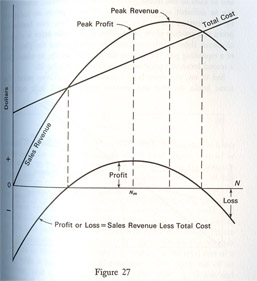
What? Man, I'm glad my job is just to read query letters and edit manuscripts. Fortunately the book enables me to answer this question:
I have a question for you. Just something I've been curious about, particularly with the continued "chick lit" craze. It seems if you write about a twenty-something in PR/fashion/event planning/publishing, there is no end to the crap that can end up on the shelves (although let me say, I do read quite a lot of it when trapped in an airport...). So here it is: In your experience, when it comes down to why a book is published, what percentage is based on "good writing" and what percentage is based on marketability?
Since there's no way for me to answer the actual question (I would just have to make up a number - it's to abstract a concept), I'll just reinterpret the question as, "What determines why you choose a book? How can you tell it will be profitable?"
Well, folks. Here it is. The actual formula to determine the profitability of your coming-of-age yarn or your Vietnam memoirs. Are you ready?
...You sure?
Here we go.

I think that should answer any questions anyone will ever have about publishing.
Monday, January 15, 2007
Working Hours
Every once in a while, on a bank holiday or a national holiday like MLK Day or Columbus Day, someone asks the question on Writer.net - Are the agents in the office today?
The answer is: Yes. No. Maybe.
An agent's schedule is an increasingly nebulous thing. Certainly, almost nobody works the traditional hours of 9-5pm, Monday through Friday. There's no particular reason to do that. Queries can be read at any time, email means agents can reply at night, and a lot of the business isn't in the office anyway. It's on the cell phone, on a portable laptop, or shuttling from lunch meeting with editor to lunch meeting with publicist to lunch meeting with author. Many agents work out of their home a lot of the time, and have various services where their work phone is redirected to their cell or home phone. Some agents don't have offices at all - or have offices for postal purposes, but they don't really exist. Downtown offices are expensive (easily $1400 a month), but many corporations offer services like providing a mailbox and a phone forwarding service and use of a conference room, so it appears your letter is going to a traditional office setting, when instead it's just being picked up by the agent and brought back to Brooklyn.
The only reason to keep a somewhat normal schedule at all (besides not being a vampire) is because publishing houses do "officially" keep more normal hours. That is, unless the agent knows the editor's private line number or his/her home number. Which the agent probably does.
My first boss used to come in at 11am after working at home for an hour or so. She would check her messages, make a couple important calls, and then leave at 12:30 for a three hour lunch with an editor, which was really little more than a business meeting with food involved and a bill at the end. She would show up again around 3pm, then still be working when I went home at 7.
My current boss has a kid, so sometimes she'll leave if school gets called off (for a snow day or something) and finish her work at home. Other times she'll come in early, go to yoga for two hours in the middle of the day, and then work until about 6.
What I'm trying to say is, you have no way of knowing when we're in the office or not, but it's not really all that relevant. The only time work fully stops is usually Sunday, or a major holiday like Christmas, when even if the agent is available, nobody else in publishing is and the mail doesn't come. The reason we're not answering our phone is not because we're not there. It's because we screen all our calls because most of them will be people pitching their novel on the answering machine, and if we picked up, we might have to listen to them. Send a query.
The answer is: Yes. No. Maybe.
An agent's schedule is an increasingly nebulous thing. Certainly, almost nobody works the traditional hours of 9-5pm, Monday through Friday. There's no particular reason to do that. Queries can be read at any time, email means agents can reply at night, and a lot of the business isn't in the office anyway. It's on the cell phone, on a portable laptop, or shuttling from lunch meeting with editor to lunch meeting with publicist to lunch meeting with author. Many agents work out of their home a lot of the time, and have various services where their work phone is redirected to their cell or home phone. Some agents don't have offices at all - or have offices for postal purposes, but they don't really exist. Downtown offices are expensive (easily $1400 a month), but many corporations offer services like providing a mailbox and a phone forwarding service and use of a conference room, so it appears your letter is going to a traditional office setting, when instead it's just being picked up by the agent and brought back to Brooklyn.
The only reason to keep a somewhat normal schedule at all (besides not being a vampire) is because publishing houses do "officially" keep more normal hours. That is, unless the agent knows the editor's private line number or his/her home number. Which the agent probably does.
My first boss used to come in at 11am after working at home for an hour or so. She would check her messages, make a couple important calls, and then leave at 12:30 for a three hour lunch with an editor, which was really little more than a business meeting with food involved and a bill at the end. She would show up again around 3pm, then still be working when I went home at 7.
My current boss has a kid, so sometimes she'll leave if school gets called off (for a snow day or something) and finish her work at home. Other times she'll come in early, go to yoga for two hours in the middle of the day, and then work until about 6.
What I'm trying to say is, you have no way of knowing when we're in the office or not, but it's not really all that relevant. The only time work fully stops is usually Sunday, or a major holiday like Christmas, when even if the agent is available, nobody else in publishing is and the mail doesn't come. The reason we're not answering our phone is not because we're not there. It's because we screen all our calls because most of them will be people pitching their novel on the answering machine, and if we picked up, we might have to listen to them. Send a query.
Sunday, January 14, 2007
Writers' Conferences
Reading through a few agent blogs, I notice that one or two mention the helpfulness of attending writer's conferences...how true is this?
I'm looking around and haven't found any in my area and even if they were, they are expensive. Is it worth several hundred dollars (plus hotels) in hope that an agent might recognize my query letter a few weeks later?
Writers' conferences are good for a lot of things - mainly, hearing agents talk. Generally, they will not be a huge help in getting you an agent unless you are exceptionally lucky. Seeing as how agents have live journals and web logs these days, I would say that it's not worth your money.
Of course, that's also because I find sitting in a room with a group of fellow unpublished, desperate writers to be the world's most depressing experience. The second is reading any issue of Writer's Digest.
I'm looking around and haven't found any in my area and even if they were, they are expensive. Is it worth several hundred dollars (plus hotels) in hope that an agent might recognize my query letter a few weeks later?
Writers' conferences are good for a lot of things - mainly, hearing agents talk. Generally, they will not be a huge help in getting you an agent unless you are exceptionally lucky. Seeing as how agents have live journals and web logs these days, I would say that it's not worth your money.
Of course, that's also because I find sitting in a room with a group of fellow unpublished, desperate writers to be the world's most depressing experience. The second is reading any issue of Writer's Digest.
Saturday, January 13, 2007
Writers on Interns
Recently I got contacted by an agent with a partial who wanted a full. The request was actually late in coming, she admitted, by a few days. I asked her where her retinue of interns were because I used to work in the same office as her and I happen to know she keeps an insane amount of unpaid Columbia student interns - like, three or four. "They're all on break!" she said. "I'm swamped."
Because, of course, colleges take 5-week recesses that go into mid-January. I'm in grad school and it's the same deal. Because my brother is an unemployed college grad and I'm on break and neither of us care about Christmas, the Rejector family takes their vacation in early January, when the hotel rates are cheaper. (If you have to fly Christmas week, December 25th is a great day to fly) So the interns are gone, home to their families. Even I, a working woman, take my week vacation in January instead of December.
So after taking normal people vacations, the agents return in January to find their assistants gone and the mail piled up. I'm heading back to New York to take care of my boss' pile ASAP. Oh, and there's also phone calls to make, deals to finish, editors to contact, contracts to fax, and planning for some major upcoming bookfairs.
I don't mean to be discouraging to you guys waiting to hear back, but the point of this web log is to tell the truth, and that's it. Don't hold your breath.
Because, of course, colleges take 5-week recesses that go into mid-January. I'm in grad school and it's the same deal. Because my brother is an unemployed college grad and I'm on break and neither of us care about Christmas, the Rejector family takes their vacation in early January, when the hotel rates are cheaper. (If you have to fly Christmas week, December 25th is a great day to fly) So the interns are gone, home to their families. Even I, a working woman, take my week vacation in January instead of December.
So after taking normal people vacations, the agents return in January to find their assistants gone and the mail piled up. I'm heading back to New York to take care of my boss' pile ASAP. Oh, and there's also phone calls to make, deals to finish, editors to contact, contracts to fax, and planning for some major upcoming bookfairs.
I don't mean to be discouraging to you guys waiting to hear back, but the point of this web log is to tell the truth, and that's it. Don't hold your breath.
Friday, January 12, 2007
Writers on Writing
Over vacation I read, along with many other books (mainly history books because I write historical fiction), Stephen King's On Writing. Think what you want about his literary style, his genres, or the overwhelming financial success we all wish we had from our writing, but one of the interesting things about Stephen King is that he can talk about things going on in his life and make them not boring. In Entertainment Weekly he has a column where he will literally spend the whole time going on about some TV show he's really into and I will read it even though I don't have a working television.
Though the book is partially his autobiography and not really discussing writing all the time, he is definitely one of the few writers who can talk about writing and not have me running for the hills. Most of the books on writing out there that I would endorse (beyond grammar books) are by editors, not writers. I suspect this is because editors are trained to analyze why a piece of writing is good or not (it's their job), while a writer just writes.
Most of the books out there are junk. Stephen King only endurses the classic Elements of Style by E. B. White and says the rest are junk. I'm a bit more liberal. Here's my list of suggested books:
Though the book is partially his autobiography and not really discussing writing all the time, he is definitely one of the few writers who can talk about writing and not have me running for the hills. Most of the books on writing out there that I would endorse (beyond grammar books) are by editors, not writers. I suspect this is because editors are trained to analyze why a piece of writing is good or not (it's their job), while a writer just writes.
Most of the books out there are junk. Stephen King only endurses the classic Elements of Style by E. B. White and says the rest are junk. I'm a bit more liberal. Here's my list of suggested books:
- The First Five Pages: A Writer's Guide to Staying Out of the Rejection Pile by Noah Lukeman (a literary agent)
- 78 Reasons Why Your Book May Never Be Published and 14 Reasons Why It Just Might by Pat Walsh (an editor at a publishing house)
- Immediate Fiction by Jerry Cleaver. Man, I wish everyone in my MFA program would read this book, which outlines how to write a basic story.
- How to Write Science Fiction and Fantasy by Orson Scott Card. It has a lot of good general advice, though his section on submitting makes it sound like getting accepted is just another minor activity. I can't blame him; it's been a while since his work was rejected.
Wednesday, January 03, 2007
I'm out. There's not really a better title.
So while the rest of the publishing industry reluctantly returns to work, I head off for vacation. Because of my school schedule, this is the best time, so I'll be away for the next week. I apologize for the slow posting schedule over the holidays, when I was either at work or ... celebrating the holidays?
Happy Non-Holidays to everyone, and all, a good night.
P.S. Try not to reply unless you have something important to say. I have to approve all comments now and they're just going to clog my inbox.
Happy Non-Holidays to everyone, and all, a good night.
P.S. Try not to reply unless you have something important to say. I have to approve all comments now and they're just going to clog my inbox.
Wednesday, December 27, 2006
The "Back In ____ " Sign
So the publishing industry is officially on vacation.
I say officially because last week we were "not in the office" the way Victorian Londoners were "not at home" when they didn't want to entertain visitors. In other words, we generally shut off our phones and spent the week getting around to the stuff that piled up. My boss called up some editors and fellow agents she needed to catch up with (contacts make an agency), now that she had the excuse of the publishing houses being closed to not be busy with them. It was also a week for reading and responding to partials, and cleaning out of the office. This included a couple of embarassing finds ("Uh, I think this requested manuscript arrived in 2005. Yeah, it did. Oops. Should we do something about this?") as we cleaned out the office - my boss is working more from home this coming year, which hopefully will not affect my job because the mail will still come to the office in Manhattan and the phone will still ring there. Many agents have offices in name only in Manhattan, because it's insanely expensive to rent office space here, and the industry has reached a point where agents can really work from home if they own a cell phone and a wireless laptop. This is why a lot of offices offer forwarding services, to make it seem like your agent has an office downtown when really they work out of their home in Brooklyn most of the time.
But this week, we're really gone. I'm only going in once, to handle the week's mail. I'm as frustrated as you guys are - I've got partials sitting at a publishing house and an agency, and I know I won't hear back until the second or third week of January at best. I feel your pain.
I say officially because last week we were "not in the office" the way Victorian Londoners were "not at home" when they didn't want to entertain visitors. In other words, we generally shut off our phones and spent the week getting around to the stuff that piled up. My boss called up some editors and fellow agents she needed to catch up with (contacts make an agency), now that she had the excuse of the publishing houses being closed to not be busy with them. It was also a week for reading and responding to partials, and cleaning out of the office. This included a couple of embarassing finds ("Uh, I think this requested manuscript arrived in 2005. Yeah, it did. Oops. Should we do something about this?") as we cleaned out the office - my boss is working more from home this coming year, which hopefully will not affect my job because the mail will still come to the office in Manhattan and the phone will still ring there. Many agents have offices in name only in Manhattan, because it's insanely expensive to rent office space here, and the industry has reached a point where agents can really work from home if they own a cell phone and a wireless laptop. This is why a lot of offices offer forwarding services, to make it seem like your agent has an office downtown when really they work out of their home in Brooklyn most of the time.
But this week, we're really gone. I'm only going in once, to handle the week's mail. I'm as frustrated as you guys are - I've got partials sitting at a publishing house and an agency, and I know I won't hear back until the second or third week of January at best. I feel your pain.
Wednesday, December 20, 2006
POD Post. Skip if you're bored with the topic.
Since starting this blog, I've been insulted in many, many ways. I've been called incompetent, immoral, and lazy. I've been labeled as "too young" (because 25-year-olds halfway through their graduate degree in fiction are definitely too young to be reading whole pages of words), "untrained" (because there's a school for reading query letters), and a "virgin" (okay, that one's true). My spelling is bad (because there's no such thing as typos on the internet, especially during late-night posts). I've sold my soul to the publishing industry because I enjoy butter (actually, like any good Jewish girl, it's cream cheese with dairy and margarine with meat. Haha! I ruined your metaphor!).
I'm sure it's a coincidence that roughly 99.999981% of the people lodging these complaints admit to being writers with unsellable POD books. In the brief moments where clarity hits me, I try to stifle my laughter. Then I go back to quietly holding back the obvious comment here. As everyone knows, if you couldn't sell your coming-of-age yarn to any publishing house because all 100 of the agents you queried rejected you for some reason with a form letter, this is a sure sign of your unqualified genius. I also work at all 100 of these agencies thanks to my wayback machine, so clearly I'm entirely to blame. It was not 100 people independently making the decision that your work sucked, or was at the very least not marketable. And what do they know? All they do is analyze, edit, and sell novels for a living. That's not any kind of professional qualification! Fortunately you read this one article on this one place online about how the publishing industry is totally corrupt and the article validated all of your beliefs. You were not a fool for giving iUniverse $300 for like 25 copies of your novel. Someday, when all of the great houses of publishing are torn down by the independent thinks of the internet, your buddy list will replace the people on those committees and your Pulitzer will be in the mail. Thank you, interweb!
And now we come to the subject of Meika. I have to say, I've never met a guy like Meika. He's an old-fashioned good sport. He puts his work on my blog to be torn to shreds, and even after I make comments and then even a post where I outright insult him and tell him to stop writing, he emails me politely and praises my blog. Talk about rolling with the punches. Meika, you are a great guy. Your incomprehensible writing has been amusing to many of us, but when it comes right down to it, you're just a nice guy. Also, thanks for giving me permission to post the rant you sent to me and also posted on someone else's blog.
What's important with the new techonologies of the web, it's not that
filtering is not needed, for it's more needed than ever.
What is important is that the slushpile (the entire web?) is available to all who enquire. If large Publishing houses only recruit slush readers from certain universities then it is only they who benefit from the slushpile experience.
I don't know where this rumor got started that agencies and publishing houses go over to the IVY league schools and recruit people. Generally the entry-level people are a bunch of people with BAs in useless things like English or History (I was History) who spent a year slacking off before realizing they might need to do something with their lives or their parents would take away their PS2, so they went out and applied to stuff on Craigslist and got an unpaid internship somewhere. You know, like basically everyone else who graduates from college in almost any field that's not pre-med. Yes, there are internships for students, and for obvious reasons, these internships are handed out mainly to students who go to school in Manhattan, because, well, the office is in Manhattan. I know some Columbia interns, some NYU interns, someone from Hunter College. It's all location.
And then get snarky on the nitwits who end up heading for the slushpile, mostly because they have no experience there.
See, if you try and connect this sentence with the previous ones that he wrote, it implies that the nitwits who read the slushpile are making fun of the nitwits who are reading the slush pile, both of whom are by association the same person, then we all are just insulting ourselves and we all don't have experience doing the thing we're doing, even though we're doing it and getting experience.
This may or may not result in guild like
restrictions on entry into the trade. Not having been there I do not
know.
Actually, if you join the AAR, you get a discount at the merchant's guild, the mercenary guild, and 20% off potions at the Mage's guild, and man are those potions expensive. Can a sister get a life potion here? Now? My elf friend is dying!
Now, the slushpile contains mistakes, its the process of rejecting
these that leads to the production of better work. In fact it is the
rejection more than selection that creates all our cultural
artifacts. (My very special philosophy is the life work of Mary
Douglas, so its not my personal one, mmmkay)
??? No, seriously, that's my whole response.
With the web its 'availability' of the slushpile, the juvenilia
(cough cough) and the cranks which changes the whole show. Not the
crap itself. This availability will directly affect the means of
production, which in publishing is actually publicity and control of
the author's name (brand).
I've made several reads through this and what I think he's trying to say is that if everyone just publishes everything all the time using the internet, we will realize that a lot of people are crappy writers and make decisions for ourselves. That or we will all become communists. Either one.
Now that more people can pick and choose and critique from the slush
there can be more approaches, more editing, and more conversations,
like this one. This conversation on this blog is part of the evidence
in support of my very special thesis. That is what other have said
about Web 2, I am merely applying it in the area of books and
writing, which appear to have the most hidebound voices in the arts.
(I'll return to that in response to self promotion).
Yes, there is something "very special" about your thesis.
I am not saying that therefore everyone should do this, nor am I
saying that this magically makes everyone good, nor even interesting,
but things have changed. The publishing houses have lost control of the slushpile.
I know! It just grew and grew and now it's actually gained self-awareness and lobbied for its own desk and zip code. As soon as it reaches the side of the room with the computer, we're all doomed. John Connor, save us!
And books like my "Doric Column" of old juvenilia will pop up before the
solution of an arch is arrived at. My book is not the solution, its
part of the conversation that will find solutions.
??? Not the grandstanding; the part about the arch. Does it have something to do with columns? Is this an architectural argument?
Indeed I have used this little gem of insight into the new domain to
structure my SF book .before Country. It takes place on a world
called Country built out of a slushpile of manuscripts, mostly pre-
Raphaelite, and earnest Hippies' blogs wishing to go back to nature.
I used to think of it as a library but the slushpile metaphor works a
lot better. Why use this? Perhaps because real life is more like a slushpile than
great literature.
Yes, that is true. Real life is actually quite boring and poorly-planned, without proper climaxes and conclusions to storylines. You're better off with the great literature.
But they are also near the publishers because audiences don't want to be the filters. True, Yes, yea verily.
Meika, I love you. That said, you are an insane person.
This is indeed true, and will continue to be true even as it changes (as been described above). I am not saying everyone will like it, and the process itself actually relies on what people 'do not like', so it obviously is going to take a while. Many do not like change.
Many people also don't like reading bad fiction. I think this is where my job comes in, to actually keep people from having to do that. Or am I just arguing semantics?
Also, after my recent experience on the interslush I may discover I am a better editor (or something) than a writer with a photoshop filter dodge-burning German sentence structure into my bipolar-narcissitic poetic style. (Say, that means I am likely just a second rate Nietzsche).
I think you would do well in an MFA program. By the way, that was an insult. On you or MFA programs? You decide.
The web is a mass of opportunities, simply restating past processes and past succesful models (and I do not disagree with their success, nor do I think they are evil or something) in the face of the change does not mean that change will not occur (or be evil or something). Self-Promotion Publishers promote. They generate publicity. They make things public. This completes the writing circle and completes the craft. (That slushpile is the key there).
Can you draw out this circle? Or make a flowcart or something? Because I'm a little confused here.
Self-publishers must also promote, thus as they are promoting themselves. They will be guilty of self-promotion. Case closed.
I hated that anime. You saw one episode, you saw them all. It was so formulaic. And how was Conan always just finding bodies everywhere? Tokyo must have an insanely high murder rate. Plus there was that creepy episode where the dentist drugged the kid so that she could commit a murder while she was asleep and have a perfect alibi...
[more cut for time and my sanity]
Now, even if I am crap, and no doubt about it, consensus here is near universal (never a good sign if your part of the herd by the way) if any part of my self-promotion helps create that culture for writers, then I have done a good thing. And that is why I posted at the rejector, not becuase I thought my crank writing are/were good, but because the new processes are going to slowly dissolve the publishing houses current methods.
"Send editors nothing, I say, and agents less."
"Something something something ... poor, huddled masses, yearing to breathe free ... something something ... et tu, Brute?" I'm not good at rote memorization. I'm glad I don't live in Qing Dynasty China.
Reclaim the slush!
You know what? You can have it.
Otherwise you'll just drown in your own shit and you'll never get better unless someone picks you out of it. Its a predicament and self-promotion is an act of agency rather than, yet again, choosing to be a victim. Get used to it.
Dude, she was not a victim. She totally led that rejection pile on, what with her clothing and her hair and those high heels and the I-don't-know-what's...
Kids these days! Honestly!
I'm sure it's a coincidence that roughly 99.999981% of the people lodging these complaints admit to being writers with unsellable POD books. In the brief moments where clarity hits me, I try to stifle my laughter. Then I go back to quietly holding back the obvious comment here. As everyone knows, if you couldn't sell your coming-of-age yarn to any publishing house because all 100 of the agents you queried rejected you for some reason with a form letter, this is a sure sign of your unqualified genius. I also work at all 100 of these agencies thanks to my wayback machine, so clearly I'm entirely to blame. It was not 100 people independently making the decision that your work sucked, or was at the very least not marketable. And what do they know? All they do is analyze, edit, and sell novels for a living. That's not any kind of professional qualification! Fortunately you read this one article on this one place online about how the publishing industry is totally corrupt and the article validated all of your beliefs. You were not a fool for giving iUniverse $300 for like 25 copies of your novel. Someday, when all of the great houses of publishing are torn down by the independent thinks of the internet, your buddy list will replace the people on those committees and your Pulitzer will be in the mail. Thank you, interweb!
And now we come to the subject of Meika. I have to say, I've never met a guy like Meika. He's an old-fashioned good sport. He puts his work on my blog to be torn to shreds, and even after I make comments and then even a post where I outright insult him and tell him to stop writing, he emails me politely and praises my blog. Talk about rolling with the punches. Meika, you are a great guy. Your incomprehensible writing has been amusing to many of us, but when it comes right down to it, you're just a nice guy. Also, thanks for giving me permission to post the rant you sent to me and also posted on someone else's blog.
What's important with the new techonologies of the web, it's not that
filtering is not needed, for it's more needed than ever.
What is important is that the slushpile (the entire web?) is available to all who enquire. If large Publishing houses only recruit slush readers from certain universities then it is only they who benefit from the slushpile experience.
I don't know where this rumor got started that agencies and publishing houses go over to the IVY league schools and recruit people. Generally the entry-level people are a bunch of people with BAs in useless things like English or History (I was History) who spent a year slacking off before realizing they might need to do something with their lives or their parents would take away their PS2, so they went out and applied to stuff on Craigslist and got an unpaid internship somewhere. You know, like basically everyone else who graduates from college in almost any field that's not pre-med. Yes, there are internships for students, and for obvious reasons, these internships are handed out mainly to students who go to school in Manhattan, because, well, the office is in Manhattan. I know some Columbia interns, some NYU interns, someone from Hunter College. It's all location.
And then get snarky on the nitwits who end up heading for the slushpile, mostly because they have no experience there.
See, if you try and connect this sentence with the previous ones that he wrote, it implies that the nitwits who read the slushpile are making fun of the nitwits who are reading the slush pile, both of whom are by association the same person, then we all are just insulting ourselves and we all don't have experience doing the thing we're doing, even though we're doing it and getting experience.
This may or may not result in guild like
restrictions on entry into the trade. Not having been there I do not
know.
Actually, if you join the AAR, you get a discount at the merchant's guild, the mercenary guild, and 20% off potions at the Mage's guild, and man are those potions expensive. Can a sister get a life potion here? Now? My elf friend is dying!
Now, the slushpile contains mistakes, its the process of rejecting
these that leads to the production of better work. In fact it is the
rejection more than selection that creates all our cultural
artifacts. (My very special philosophy is the life work of Mary
Douglas, so its not my personal one, mmmkay)
??? No, seriously, that's my whole response.
With the web its 'availability' of the slushpile, the juvenilia
(cough cough) and the cranks which changes the whole show. Not the
crap itself. This availability will directly affect the means of
production, which in publishing is actually publicity and control of
the author's name (brand).
I've made several reads through this and what I think he's trying to say is that if everyone just publishes everything all the time using the internet, we will realize that a lot of people are crappy writers and make decisions for ourselves. That or we will all become communists. Either one.
Now that more people can pick and choose and critique from the slush
there can be more approaches, more editing, and more conversations,
like this one. This conversation on this blog is part of the evidence
in support of my very special thesis. That is what other have said
about Web 2, I am merely applying it in the area of books and
writing, which appear to have the most hidebound voices in the arts.
(I'll return to that in response to self promotion).
Yes, there is something "very special" about your thesis.
I am not saying that therefore everyone should do this, nor am I
saying that this magically makes everyone good, nor even interesting,
but things have changed. The publishing houses have lost control of the slushpile.
I know! It just grew and grew and now it's actually gained self-awareness and lobbied for its own desk and zip code. As soon as it reaches the side of the room with the computer, we're all doomed. John Connor, save us!
And books like my "Doric Column" of old juvenilia will pop up before the
solution of an arch is arrived at. My book is not the solution, its
part of the conversation that will find solutions.
??? Not the grandstanding; the part about the arch. Does it have something to do with columns? Is this an architectural argument?
Indeed I have used this little gem of insight into the new domain to
structure my SF book .before Country. It takes place on a world
called Country built out of a slushpile of manuscripts, mostly pre-
Raphaelite, and earnest Hippies' blogs wishing to go back to nature.
I used to think of it as a library but the slushpile metaphor works a
lot better. Why use this? Perhaps because real life is more like a slushpile than
great literature.
Yes, that is true. Real life is actually quite boring and poorly-planned, without proper climaxes and conclusions to storylines. You're better off with the great literature.
But they are also near the publishers because audiences don't want to be the filters. True, Yes, yea verily.
Meika, I love you. That said, you are an insane person.
This is indeed true, and will continue to be true even as it changes (as been described above). I am not saying everyone will like it, and the process itself actually relies on what people 'do not like', so it obviously is going to take a while. Many do not like change.
Many people also don't like reading bad fiction. I think this is where my job comes in, to actually keep people from having to do that. Or am I just arguing semantics?
Also, after my recent experience on the interslush I may discover I am a better editor (or something) than a writer with a photoshop filter dodge-burning German sentence structure into my bipolar-narcissitic poetic style. (Say, that means I am likely just a second rate Nietzsche).
I think you would do well in an MFA program. By the way, that was an insult. On you or MFA programs? You decide.
The web is a mass of opportunities, simply restating past processes and past succesful models (and I do not disagree with their success, nor do I think they are evil or something) in the face of the change does not mean that change will not occur (or be evil or something). Self-Promotion Publishers promote. They generate publicity. They make things public. This completes the writing circle and completes the craft. (That slushpile is the key there).
Can you draw out this circle? Or make a flowcart or something? Because I'm a little confused here.
Self-publishers must also promote, thus as they are promoting themselves. They will be guilty of self-promotion. Case closed.
I hated that anime. You saw one episode, you saw them all. It was so formulaic. And how was Conan always just finding bodies everywhere? Tokyo must have an insanely high murder rate. Plus there was that creepy episode where the dentist drugged the kid so that she could commit a murder while she was asleep and have a perfect alibi...
[more cut for time and my sanity]
Now, even if I am crap, and no doubt about it, consensus here is near universal (never a good sign if your part of the herd by the way) if any part of my self-promotion helps create that culture for writers, then I have done a good thing. And that is why I posted at the rejector, not becuase I thought my crank writing are/were good, but because the new processes are going to slowly dissolve the publishing houses current methods.
"Send editors nothing, I say, and agents less."
"Something something something ... poor, huddled masses, yearing to breathe free ... something something ... et tu, Brute?" I'm not good at rote memorization. I'm glad I don't live in Qing Dynasty China.
Reclaim the slush!
You know what? You can have it.
Otherwise you'll just drown in your own shit and you'll never get better unless someone picks you out of it. Its a predicament and self-promotion is an act of agency rather than, yet again, choosing to be a victim. Get used to it.
Dude, she was not a victim. She totally led that rejection pile on, what with her clothing and her hair and those high heels and the I-don't-know-what's...
Kids these days! Honestly!
The ReganBooks Fallout
Unless you lived in a hole last month, you're aware that OJ Simpson wrote a book about "how he would have killed his wife." There might have been a little moral ambiguity there, considering his wife is dead and he most likely killed her. Still, it would have sold really well.
The thing that made this media story even more complex was that it actually began with Judith Regan, the head of the ReganBooks imprint at Harpercollins, being interviewed and saying that she "considered it his confession." Or at least, that's how I first heard about this nonesense, because I don't have television and get my news online.
By the end of it, Judith was fired, allegedly for "anti-Semitic remarks." Now it's somewhat known in the industry that she has a bit of a mouth on her, which is a much lesser charge than being an anti-Semite. The general consensus among ... my boss ... is that she probably would have kept her job if she kept her mouth shut and let it blow over, but she didn't, and so she's gone.
... Which is a problem. Reganbooks isn't just Judith Regan - a lot of people work there and a lot of authors have contracts with it, not all of them ex-athletes who did drugs and/or killed their wives. My boss currently has a second book option about to expire with ReganBooks, which published the author's previous book last year and it was a moderate success and has gone into translation markets. She was literally a day or so away from the author when Miss Regan was fired. My boss then had to worry that everyone else in the imprint would be fired, which eventually it was determined that they weren't and that it would continue to exist. However, there is such a shake-up over there that they're not making offers at the moment, and meanwhile the second-book clause in the contract expires December 28th. So it's a bad situation all around.
Anyway, just a little insider story for you all.
The thing that made this media story even more complex was that it actually began with Judith Regan, the head of the ReganBooks imprint at Harpercollins, being interviewed and saying that she "considered it his confession." Or at least, that's how I first heard about this nonesense, because I don't have television and get my news online.
By the end of it, Judith was fired, allegedly for "anti-Semitic remarks." Now it's somewhat known in the industry that she has a bit of a mouth on her, which is a much lesser charge than being an anti-Semite. The general consensus among ... my boss ... is that she probably would have kept her job if she kept her mouth shut and let it blow over, but she didn't, and so she's gone.
... Which is a problem. Reganbooks isn't just Judith Regan - a lot of people work there and a lot of authors have contracts with it, not all of them ex-athletes who did drugs and/or killed their wives. My boss currently has a second book option about to expire with ReganBooks, which published the author's previous book last year and it was a moderate success and has gone into translation markets. She was literally a day or so away from the author when Miss Regan was fired. My boss then had to worry that everyone else in the imprint would be fired, which eventually it was determined that they weren't and that it would continue to exist. However, there is such a shake-up over there that they're not making offers at the moment, and meanwhile the second-book clause in the contract expires December 28th. So it's a bad situation all around.
Anyway, just a little insider story for you all.
Friday, December 15, 2006
Living Wage as a Writer
Some people have been emailing me and trying to do the math about being a working writer. The fact is, it's impossible math to do. Yes, there are people who live entirely off their novel writing. These people are few and far between - and not only that, but they usually have totally different financial setups when they do their taxes. Let me give some examples:
(1) The great novelist - Has probably won a Pulitzer at some point, or the National Book Award. Everything he (it's usually a he) writes will be a bestseller no matter how bad it is, at least for the first two weeks. He'll always get a review in the New York Times Book Review, probably close to the front. To live fairly comfortably, he only has to produce a book about once a decade, which is probably around his output anyway. Examples would be Philip Roth, Thomas Pychon.
(2) The bestseller - This guy or girl just writes really, really marketable stuff, and not only that, but produces it on a regular basis of every 1-2 years. He/she usually gets hammered by critics but is at the top of the list anyway, and his/her old stuff is always in print. This person could have retired years ago, financially, but simply can't stop writing - because he's a real writer. And for real writers, writing is like breathing. His breath just happens to be very commercial. Examples would be Stephen King, Tom Clancy, John Grisham.
(3) The mid-list author: Had one break-out hit, regularly produces a book a year that goes for 30-40,000 advance, possible royalties depending on the reviews. Probably works in a genre like fantasy or horror or mystery, because mid-list authors don't survive in general fiction. Eventually, he/she will probably get an offer to write some material for some fantasy series (like the Dragonlance novels) and will do it, but under a different name.
(4) The one-book author - Very, very few one-book authors can live off the proceeds of that book. You know their names and have read their books - JD Salinger, Cervantes, Dan Brown. (I can't believe Cervantes went in the same sentence as Dan Brown) Chances are, these writers have other material - some of it published, some sitting on a shelf - that you or may not have heard of or read. The point is, they wrote a classic of literature (or just something that sold enough to have them swimming in one-dollar coins like Scrooge McDuck). These people come along maybe a couple times a century.
I'm leaving stuff out here, but it's time for Shabbos. Happy Chanukah. And no, there isn't an official spelling of the holiday.
(1) The great novelist - Has probably won a Pulitzer at some point, or the National Book Award. Everything he (it's usually a he) writes will be a bestseller no matter how bad it is, at least for the first two weeks. He'll always get a review in the New York Times Book Review, probably close to the front. To live fairly comfortably, he only has to produce a book about once a decade, which is probably around his output anyway. Examples would be Philip Roth, Thomas Pychon.
(2) The bestseller - This guy or girl just writes really, really marketable stuff, and not only that, but produces it on a regular basis of every 1-2 years. He/she usually gets hammered by critics but is at the top of the list anyway, and his/her old stuff is always in print. This person could have retired years ago, financially, but simply can't stop writing - because he's a real writer. And for real writers, writing is like breathing. His breath just happens to be very commercial. Examples would be Stephen King, Tom Clancy, John Grisham.
(3) The mid-list author: Had one break-out hit, regularly produces a book a year that goes for 30-40,000 advance, possible royalties depending on the reviews. Probably works in a genre like fantasy or horror or mystery, because mid-list authors don't survive in general fiction. Eventually, he/she will probably get an offer to write some material for some fantasy series (like the Dragonlance novels) and will do it, but under a different name.
(4) The one-book author - Very, very few one-book authors can live off the proceeds of that book. You know their names and have read their books - JD Salinger, Cervantes, Dan Brown. (I can't believe Cervantes went in the same sentence as Dan Brown) Chances are, these writers have other material - some of it published, some sitting on a shelf - that you or may not have heard of or read. The point is, they wrote a classic of literature (or just something that sold enough to have them swimming in one-dollar coins like Scrooge McDuck). These people come along maybe a couple times a century.
I'm leaving stuff out here, but it's time for Shabbos. Happy Chanukah. And no, there isn't an official spelling of the holiday.
Thursday, December 14, 2006
Laughing At and With - How They're Different
I have been called many things. I have been called by my legal name, my Hebrew name, "Hey you!" Miss Rejecter, Rejector, and various other things usually related to roleplaying game characters. I have to say, being called someone's "maiden aunt on a dope free day" pretty much takes the cake. I am stupified. I understand that the words that are coming out of his mouth are meant to have some kind of meaning, and that taken apart, they can be found in a dictionary, but seriously. Does it mean I speak with exceptional clarity for a virgin with a nephew? That wasn't really the tone I was going for on this blog, but hey - whatever floats your boat.
Allow me to be clear about this - if you post a link to your crappy POD or eBook, and I respond by saying something that can be easily translated into, "Uh, you suck. No, as a writer. You might suck as a person, too, but I don't know that for sure yet," I am not offering constructive criticism. Do not thank me. Stop writing. Very few responders to the previous posts's thread posting of a .pdf novel actually meant to offer constructive criticism. They meant to insult you. I just don't know how to say it more simply. We are not laughing with you, we are laughing at you. You cannot have a positive attitude and start laughing with us in some fashion to negate the general feeling that you are a terrible writer. Also, that old adage that any publicity is good publicity is not true in the writing world. You just look like a dork who can't spell or write anything sensical to more people than you previously did. This is not a cause for celebration.
Normally I don't feel like crushing writer's dreams, but when I do, well, that's a real indicator that maybe your dreams to be crushed. Or at least, not posted on my blog.
Allow me to be clear about this - if you post a link to your crappy POD or eBook, and I respond by saying something that can be easily translated into, "Uh, you suck. No, as a writer. You might suck as a person, too, but I don't know that for sure yet," I am not offering constructive criticism. Do not thank me. Stop writing. Very few responders to the previous posts's thread posting of a .pdf novel actually meant to offer constructive criticism. They meant to insult you. I just don't know how to say it more simply. We are not laughing with you, we are laughing at you. You cannot have a positive attitude and start laughing with us in some fashion to negate the general feeling that you are a terrible writer. Also, that old adage that any publicity is good publicity is not true in the writing world. You just look like a dork who can't spell or write anything sensical to more people than you previously did. This is not a cause for celebration.
Normally I don't feel like crushing writer's dreams, but when I do, well, that's a real indicator that maybe your dreams to be crushed. Or at least, not posted on my blog.
Monday, December 11, 2006
E-Books and PODs
Rejecter,
Perhaps I merely missed it, but what is your stance on a fully-realized PDF of a work as opposed to a manuscript.
Initially, I queried and sent out manuscripts as it has always been done. Now I am finding it hard to justify this antiquated process when I can format it as I wish and send a finished E-book PDF.
If the work is rejected, then I can go right to POD or something similar. Is this flawed logic? I have two novellas in the final stages and have to prepare myself.
I'm not sure the question that's being asked here, so I'll just ramble for a while and see where it takes us and how much trouble it gets me into.
From what I can gather, you submitted a normal manuscript and it was rejected, so now you are considering publishing it independently as an E-Book. (Whether it's in .pdf or .cbr or any other format is irrelevant, except when it comes to reading the book on iPods and whatnot)
I don't know a lot about publishers who work exclusively on E-Books, for two reasons. One, most major publishing houses now have their own ways of putting out E-Books if they think it's commercially viable for a product they already own and they normally include something about that in their contract, about rights and royalties and stuff. Two, I've never in my life purchased an E-Book. I've downloaded books in .txt format, but that's mainly been for research purposes (quote searches and the like). I've never actually sat down and read a novel on a computer screen, except when I had to at work, or when it's fanfic. I prefer things that I can hold in my hand and don't hurt my eyes after hours and hours. Stan Lee put it best when he said, "Computers will never replace the experience of holding a comic book in your hand and reading it." Of course, he was talking about comic books. And he was not anticipating Comic Book Reader, which really does make them readable on a screen.
There's not a lot of money or publicity in E-Books, though it is a growing market. Major publishers generally don't put out their regular books as E-Books unless there's a reason because the material can be so readily distributed illegally.
If you're looking at it like E-Book is a step below normal publishing and a step above POD publishing, I would say you are wrong. E-Books are really their own market, a market that's so rapidly changing that I don't really keep track of it and it usually doesn't show up on my radar. (By the way, it's a bad sign when a type of book doesn't show up on my radar)
Now getting into the larger question of whether you should go ahead with your manuscript in other publishing forms - the publishing industry answer is, "Uh, if you want to, but if we rejected it across the board, it probably sucked. Go write a better book instead." If you come and tell me that every single agent you queried didn't request a partial, I would say something was wrong with your query letter. If you say you got some hits but nobody took you on as a client, you've got something wrong with your manuscript.
There are reasons to publish POD. If you want to just have your book in print for friends and maybe some people who'll find it online and be interested, and you don't want to deal with the publishing industry or the hassle of receiving profits from your work, go ahead. If you've written poetry and it hasn't won a Pulitzer, go ahead, because we won't publish it anyway. But if you've written a novel that you actually want massive amounts of peope to read - say, more than 100 - then you should stick with traditional publishing.
Of course, this is coming from the assistant to an agent who wouldn't dream of sending her clients to a POD publisher. This is also coming from a grad student who sat in line during registration today and listened to people go on and on about how they were just going straight to POD and then build a huge following via the internet because the INTERNET can do ANYTHING and you should definitely not listen to the person behind you in line who actually works in publishing and is telling you that the chances of you actually having a successful POD book is almost nil. Yeah, yeah, Amazon.com is great. We all love it. You know what I don't like? Buying paperbacks of shitty quality with bad covers, no editing, poor formatting, and cost me $20.00. Thanks, iUniverse.
If you are being rejected across the board by traditional publishing when you've written a traditional manuscript - not the two novellas you discuss later in your letter - then yes, you can consider POD or E-Book. Or you could maybe question how good your manuscript was in the first place to be rejected by everyone across the board.
Perhaps I merely missed it, but what is your stance on a fully-realized PDF of a work as opposed to a manuscript.
Initially, I queried and sent out manuscripts as it has always been done. Now I am finding it hard to justify this antiquated process when I can format it as I wish and send a finished E-book PDF.
If the work is rejected, then I can go right to POD or something similar. Is this flawed logic? I have two novellas in the final stages and have to prepare myself.
I'm not sure the question that's being asked here, so I'll just ramble for a while and see where it takes us and how much trouble it gets me into.
From what I can gather, you submitted a normal manuscript and it was rejected, so now you are considering publishing it independently as an E-Book. (Whether it's in .pdf or .cbr or any other format is irrelevant, except when it comes to reading the book on iPods and whatnot)
I don't know a lot about publishers who work exclusively on E-Books, for two reasons. One, most major publishing houses now have their own ways of putting out E-Books if they think it's commercially viable for a product they already own and they normally include something about that in their contract, about rights and royalties and stuff. Two, I've never in my life purchased an E-Book. I've downloaded books in .txt format, but that's mainly been for research purposes (quote searches and the like). I've never actually sat down and read a novel on a computer screen, except when I had to at work, or when it's fanfic. I prefer things that I can hold in my hand and don't hurt my eyes after hours and hours. Stan Lee put it best when he said, "Computers will never replace the experience of holding a comic book in your hand and reading it." Of course, he was talking about comic books. And he was not anticipating Comic Book Reader, which really does make them readable on a screen.
There's not a lot of money or publicity in E-Books, though it is a growing market. Major publishers generally don't put out their regular books as E-Books unless there's a reason because the material can be so readily distributed illegally.
If you're looking at it like E-Book is a step below normal publishing and a step above POD publishing, I would say you are wrong. E-Books are really their own market, a market that's so rapidly changing that I don't really keep track of it and it usually doesn't show up on my radar. (By the way, it's a bad sign when a type of book doesn't show up on my radar)
Now getting into the larger question of whether you should go ahead with your manuscript in other publishing forms - the publishing industry answer is, "Uh, if you want to, but if we rejected it across the board, it probably sucked. Go write a better book instead." If you come and tell me that every single agent you queried didn't request a partial, I would say something was wrong with your query letter. If you say you got some hits but nobody took you on as a client, you've got something wrong with your manuscript.
There are reasons to publish POD. If you want to just have your book in print for friends and maybe some people who'll find it online and be interested, and you don't want to deal with the publishing industry or the hassle of receiving profits from your work, go ahead. If you've written poetry and it hasn't won a Pulitzer, go ahead, because we won't publish it anyway. But if you've written a novel that you actually want massive amounts of peope to read - say, more than 100 - then you should stick with traditional publishing.
Of course, this is coming from the assistant to an agent who wouldn't dream of sending her clients to a POD publisher. This is also coming from a grad student who sat in line during registration today and listened to people go on and on about how they were just going straight to POD and then build a huge following via the internet because the INTERNET can do ANYTHING and you should definitely not listen to the person behind you in line who actually works in publishing and is telling you that the chances of you actually having a successful POD book is almost nil. Yeah, yeah, Amazon.com is great. We all love it. You know what I don't like? Buying paperbacks of shitty quality with bad covers, no editing, poor formatting, and cost me $20.00. Thanks, iUniverse.
If you are being rejected across the board by traditional publishing when you've written a traditional manuscript - not the two novellas you discuss later in your letter - then yes, you can consider POD or E-Book. Or you could maybe question how good your manuscript was in the first place to be rejected by everyone across the board.
Sunday, December 10, 2006
Font
Oh Great Rejecter,
Can you please settle this argument for us bumbling masses. Do agents and publishers not take you seriously if you submit your manuscript in Times New Roman as opposed to Courier?
So, funny story. I always used to use Courier New for just about everything - my papers, things I submitted, stuff I published on the web. I loved to write in it. Then I started reading other people's full manuscripts in Courier New and discovered how irritating on the eyes it was in comparison to Times New Roman, Garamound, or even Arial. I won't judge your manuscript by your font (unless it's in Wingdings), but seriously, Times New Roman. 12 point.
Thank you, future authors.
Can you please settle this argument for us bumbling masses. Do agents and publishers not take you seriously if you submit your manuscript in Times New Roman as opposed to Courier?
So, funny story. I always used to use Courier New for just about everything - my papers, things I submitted, stuff I published on the web. I loved to write in it. Then I started reading other people's full manuscripts in Courier New and discovered how irritating on the eyes it was in comparison to Times New Roman, Garamound, or even Arial. I won't judge your manuscript by your font (unless it's in Wingdings), but seriously, Times New Roman. 12 point.
Thank you, future authors.
Naming Assistants in Your Query
Dear Rejecter,
A friend recently gave me a name of a friend who works as an assistant at a large literary agency. I would like to query this assistant. I don't know which agent she works for or if she works for more than one. Also, I queried one of the agents there over a month ago but did not get a reply. My question is, how should I phrase my query? Is it "correct" to query an assistant at all? I enjoy reading your blog and would appreciate your insight.
I would say it's not a good idea. First of all, assistants move around a lot, and you have no idea if she still works there. Second, a good assistant is looking for work to pass to the agent, so throwing around the assistant's name might make her feel good when she opens the mail, but it won't make her look at your work any differently.
A friend recently gave me a name of a friend who works as an assistant at a large literary agency. I would like to query this assistant. I don't know which agent she works for or if she works for more than one. Also, I queried one of the agents there over a month ago but did not get a reply. My question is, how should I phrase my query? Is it "correct" to query an assistant at all? I enjoy reading your blog and would appreciate your insight.
I would say it's not a good idea. First of all, assistants move around a lot, and you have no idea if she still works there. Second, a good assistant is looking for work to pass to the agent, so throwing around the assistant's name might make her feel good when she opens the mail, but it won't make her look at your work any differently.
Subscribe to:
Posts (Atom)